


Page 23 - Read Online
P. 23
Hong et al. Soft Sci 2023;3:29  https://dx.doi.org/10.20517/ss.2023.20            Page 7 of 16


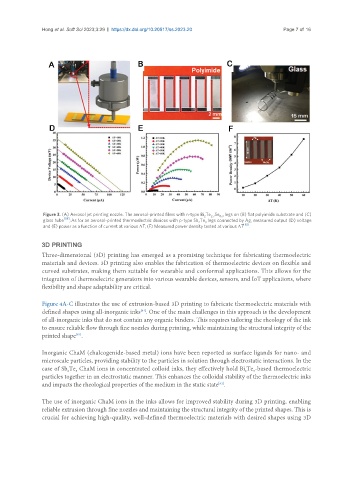
                Figure 3. (A) Aerosol jet printing nozzle. The aerosol-printed films with n-type Bi Te Se  legs on (B) flat polyimide substrate and (C)
                                                                      2  2.7  0.3
                       [88]
                glass tube  ; As for an aerosol-printed thermoelectric devices with p-type Sb Te  legs connected by Ag, measured output (D) voltage
                                                                    2  3
                and (E) power as a function of current at various ΔT; (F) Measured power density tested at various ΔT [63] .
               3D PRINTING
               Three-dimensional (3D) printing has emerged as a promising technique for fabricating thermoelectric
               materials and devices. 3D printing also enables the fabrication of thermoelectric devices on flexible and
               curved substrates, making them suitable for wearable and conformal applications. This allows for the
               integration of thermoelectric generators into various wearable devices, sensors, and IoT applications, where
               flexibility and shape adaptability are critical.

               Figure 4A-C illustrates the use of extrusion-based 3D printing to fabricate thermoelectric materials with
               defined shapes using all-inorganic inks . One of the main challenges in this approach is the development
                                                [61]
               of all-inorganic inks that do not contain any organic binders. This requires tailoring the rheology of the ink
               to ensure reliable flow through fine nozzles during printing, while maintaining the structural integrity of the
               printed shape .
                           [61]
               Inorganic ChaM (chalcogenide-based metal) ions have been reported as surface ligands for nano- and
               microscale particles, providing stability to the particles in solution through electrostatic interactions. In the
               case of Sb Te  ChaM ions in concentrated colloid inks, they effectively hold Bi Te -based thermoelectric
                                                                                      3
                           3
                                                                                    2
                        2
               particles together in an electrostatic manner. This enhances the colloidal stability of the thermoelectric inks
                                                                           [61]
               and impacts the rheological properties of the medium in the static state .
               The use of inorganic ChaM ions in the inks allows for improved stability during 3D printing, enabling
               reliable extrusion through fine nozzles and maintaining the structural integrity of the printed shapes. This is
               crucial for achieving high-quality, well-defined thermoelectric materials with desired shapes using 3D

