


Page 25 - Read Online
P. 25
Hong et al. Soft Sci 2023;3:29  https://dx.doi.org/10.20517/ss.2023.20            Page 9 of 16


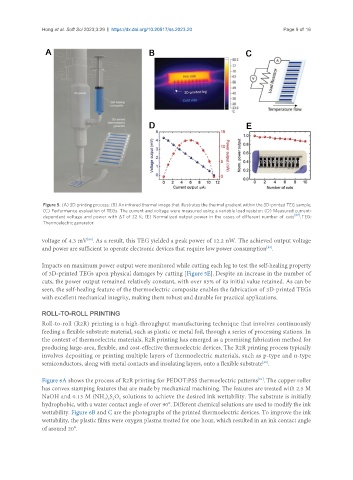
                Figure 5. (A) 3D printing process; (B) An infrared thermal image that illustrates the thermal gradient within the 3D-printed TEG sample;
                (C) Performance evaluation of TEGs. The current and voltage were measured using a variable load resistor; (D) Measured current-
                                                                                                    [89]
                dependent voltage and power with ΔT of 32 K; (E) Normalized output power in the cases of different number of  cuts  . TEG:
                Thermoelectric generator.

               voltage of 4.3 mV . As a result, this TEG yielded a peak power of 12.2 nW. The achieved output voltage
                              [89]
                                                                                           [89]
               and power are sufficient to operate electronic devices that require low power consumption .
               Impacts on maximum power output were monitored while cutting each leg to test the self-healing property
               of 3D-printed TEGs upon physical damages by cutting [Figure 5E]. Despite an increase in the number of
               cuts, the power output remained relatively constant, with over 85% of its initial value retained. As can be
               seen, the self-healing feature of the thermoelectric composite enables the fabrication of 3D-printed TEGs
               with excellent mechanical integrity, making them robust and durable for practical applications.


               ROLL-TO-ROLL PRINTING
               Roll-to-roll (R2R) printing is a high-throughput manufacturing technique that involves continuously
               feeding a flexible substrate material, such as plastic or metal foil, through a series of processing stations. In
               the context of thermoelectric materials, R2R printing has emerged as a promising fabrication method for
               producing large-area, flexible, and cost-effective thermoelectric devices. The R2R printing process typically
               involves depositing or printing multiple layers of thermoelectric materials, such as p-type and n-type
               semiconductors, along with metal contacts and insulating layers, onto a flexible substrate .
                                                                                         [90]
                                                                                        [91]
               Figure 6A shows the process of R2R printing for PEDOT:PSS thermoelectric patterns . The copper roller
               has convex stamping features that are made by mechanical machining. The features are treated with 2.5 M
               NaOH and 0.13 M (NH ) S O  solutions to achieve the desired ink wettability. The substrate is initially
                                         8
                                    4 2 2
               hydrophobic, with a water contact angle of over 90°. Different chemical solutions are used to modify the ink
               wettability. Figure 6B and C are the photographs of the printed thermoelectric devices. To improve the ink
               wettability, the plastic films were oxygen plasma treated for one hour, which resulted in an ink contact angle
               of around 20°.

