


Page 27 - Read Online
P. 27
Hong et al. Soft Sci 2023;3:29  https://dx.doi.org/10.20517/ss.2023.20           Page 11 of 16


                                                                                      [94]
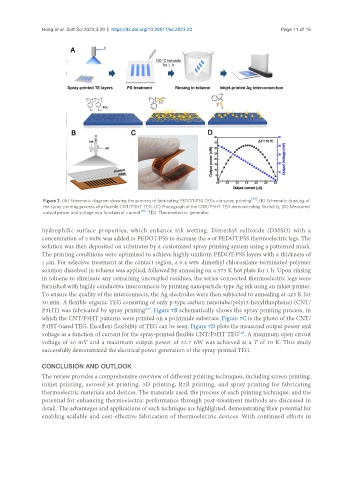
                Figure 7. (A) Schematic diagram showing the process of fabricating PEDOT:PSS TEGs via spray printing  ; (B) Schematic drawing of
                the spray-printing process of a flexible CNT/P3HT TEG; (C) Photograph of the CNT/P3HT TEG demonstrating flexibility; (D) Measured
                                                [65]
                output power and voltage as a function of current  . TEG: Thermoelectric generator.
               hydrophilic surface properties, which enhance ink wetting. Dimethyl sulfoxide (DMSO) with a
               concentration of 5 vol% was added to PEDOT:PSS to increase the σ of PEDOT:PSS thermoelectric legs. The
               solution was then deposited on substrates by a customized spray printing system using a patterned mask.
               The printing conditions were optimized to achieve highly uniform PEDOT:PSS layers with a thickness of
               1 μm. For selective treatment at the contact region, a 0.4 wt% dimethyl chlorosilane-terminated polymer
               solution dissolved in toluene was applied, followed by annealing on a 373 K hot plate for 1 h. Upon rinsing
               in toluene to eliminate any remaining uncoupled residues, the series-connected thermoelectric legs were
               furnished with highly conductive interconnects by printing nanoparticle-type Ag ink using an inkjet printer.
               To ensure the quality of the interconnects, the Ag electrodes were then subjected to annealing at 423 K for
               30 min. A flexible organic TEG consisting of only p-type carbon nanotube/poly(3-hexylthiophene) (CNT/
                                                  [65]
               P3HT) was fabricated by spray printing . Figure 7B schematically shows the spray printing process, in
               which the CNT/P3HT patterns were printed on a polyimide substrate. Figure 7C is the photo of the CNT/
               P3HT-based TEG. Excellent flexibility of TEG can be seen. Figure 7D plots the measured output power and
               voltage as a function of current for the spray-printed flexible CNT/P3HT TEG . A maximum open circuit
                                                                                  [65]
               voltage of 40 mV and a maximum output power of 32.7 nW was achieved at a T of 10 K. This study
               successfully demonstrated the electrical power generation of the spray-printed TEG.


               CONCLUSION AND OUTLOOK
               The review provides a comprehensive overview of different printing techniques, including screen printing,
               inkjet printing, aerosol jet printing, 3D printing, R2R printing, and spray printing for fabricating
               thermoelectric materials and devices. The materials used, the process of each printing technique, and the
               potential for enhancing thermoelectric performance through post-treatment methods are discussed in
               detail. The advantages and applications of each technique are highlighted, demonstrating their potential for
               enabling scalable and cost-effective fabrication of thermoelectric devices. With continued efforts in

