


Page 24 - Read Online
P. 24
Page 8 of 16                            Hong et al. Soft Sci 2023;3:29  https://dx.doi.org/10.20517/ss.2023.20


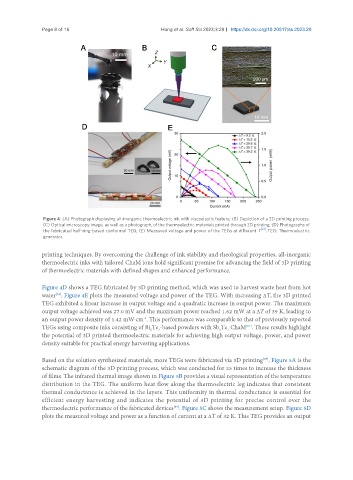
                Figure 4. (A) Photograph displaying all-inorganic thermoelectric ink with viscoelastic feature; (B) Depiction of a 3D printing process;
                (C) Optical microscopy image, as well as a photograph, of the thermoelectric materials printed through 3D printing; (D) Photographs of
                the fabricated half-ring-based conformal TEG; (E) Measured voltage and power of the TEGs at different  T [61] . TEG: Thermoelectric
                generator.


               printing techniques. By overcoming the challenge of ink stability and rheological properties, all-inorganic
               thermoelectric inks with tailored ChaM ions hold significant promise for advancing the field of 3D printing
               of thermoelectric materials with defined shapes and enhanced performance.


               Figure 4D shows a TEG fabricated by 3D printing method, which was used to harvest waste heat from hot
                    [61]
               water . Figure 4E plots the measured voltage and power of the TEG. With increasing ΔT, the 3D printed
               TEG exhibited a linear increase in output voltage and a quadratic increase in output power. The maximum
               output voltage achieved was 27.0 mV and the maximum power reached 1.62 mW at a ΔT of 39 K, leading to
                                                 -2
               an output power density of 1.42 mW·cm . This performance was comparable to that of previously reported
               TEGs using composite inks consisting of Bi Te -based powders with Sb Te  ChaM . These results highlight
                                                                                    [61]
                                                                           2
                                                    2
                                                      3
                                                                              3
               the potential of 3D printed thermoelectric materials for achieving high output voltage, power, and power
               density suitable for practical energy harvesting applications.
               Based on the solution synthesized materials, more TEGs were fabricated via 3D printing . Figure 5A is the
                                                                                          [89]
               schematic diagram of the 3D printing process, which was conducted for 25 times to increase the thickness
               of films. The infrared thermal image shown in Figure 5B provides a visual representation of the temperature
               distribution in the TEG. The uniform heat flow along the thermoelectric leg indicates that consistent
               thermal conductance is achieved in the layers. This uniformity in thermal conductance is essential for
               efficient energy harvesting and indicates the potential of 3D printing for precise control over the
               thermoelectric performance of the fabricated devices . Figure 5C shows the measurement setup. Figure 5D
                                                            [89]
               plots the measured voltage and power as a function of current at a ΔT of 32 K. This TEG provides an output

