


Page 19 - Read Online
P. 19
Hong et al. Soft Sci 2023;3:29  https://dx.doi.org/10.20517/ss.2023.20            Page 3 of 16

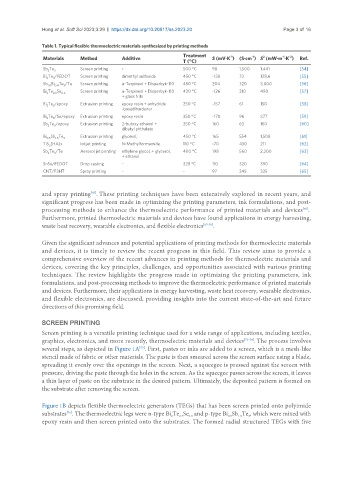
               Table 1. Typical flexible thermoelectric materials synthesized by printing methods
                                                               Treatment       -1     -1  2     -1  -2
                Materials   Method        Additive                       S (mV·K ) (S·cm ) S  (mW·m ·K )  Ref.
                                                               T (°C)
                Sb Te       Screen printing  -                 500 °C    98       1,500  1,441        [54]
                 2  3
                Bi Te /PEDOT  Screen printing  dimethyl sulfoxide  450 °C  -138   73     138.6        [55]
                 2
                   3
                Sb Bi Te /Te  Screen printing  α-Terpineol + Disperbyk-110  450 °C  204  720  3,000   [56]
                 1.6  0.4  3
                Bi Te Se 0.2  Screen printing  α-Terpineol + Disperbyk-110    430 °C  -126  310  490  [57]
                   2.8
                 2
                                          + glass frits
                Bi Te /epoxy  Extrusion printing  epoxy resin + anhydride   250 °C  -157  61  150     [58]
                 2  3
                                          -based hardener
                Bi Te /Se/epoxy  Extrusion printing  epoxy resin  350 °C  -170    96     277          [59]
                 2  3
                Sb Te /epoxy  Extrusion printing  2-butoxy ethanol +    250 °C  160  63  160          [60]
                 2
                   3
                                          dibutyl phthalate
                Bi Sb Te 3  Extrusion printing  glycerol,      450 °C    165      554    1,508        [61]
                 0.5
                    1.5
                TiS (HA)x   Inkjet printing  N-Methylformamide  110 °C   -70      430    211          [62]
                  2
                Sb Te /Te   Aerosol jet printing  ethylene glycol, + glycerol,    400 °C  198  560  2,200  [63]
                 2
                   3
                                          + ethanol
                SnSe/PEDOT  Drop casting  -                    328 °C    110      320    390          [64]
                CNT/P3HT    Spray printing  -                  -         97       345    325          [65]
               and spray printing . These printing techniques have been extensively explored in recent years, and
                                [65]
               significant progress has been made in optimizing the printing parameters, ink formulations, and post-
                                                                                                       [66]
               processing methods to enhance the thermoelectric performance of printed materials and devices .
               Furthermore, printed thermoelectric materials and devices have found applications in energy harvesting,
               waste heat recovery, wearable electronics, and flexible electronics [67-70] .
               Given the significant advances and potential applications of printing methods for thermoelectric materials
               and devices, it is timely to review the recent progress in this field. This review aims to provide a
               comprehensive overview of the recent advances in printing methods for thermoelectric materials and
               devices, covering the key principles, challenges, and opportunities associated with various printing
               techniques. The review highlights the progress made in optimizing the printing parameters, ink
               formulations, and post-processing methods to improve the thermoelectric performance of printed materials
               and devices. Furthermore, their applications in energy harvesting, waste heat recovery, wearable electronics,
               and flexible electronics, are discussed, providing insights into the current state-of-the-art and future
               directions of this promising field.

               SCREEN PRINTING
               Screen printing is a versatile printing technique used for a wide range of applications, including textiles,
               graphics, electronics, and more recently, thermoelectric materials and devices [71-74] . The process involves
                                                [75]
               several steps, as depicted in Figure 1A . First, pastes or inks are added to a screen, which is a mesh-like
               stencil made of fabric or other materials. The paste is then smeared across the screen surface using a blade,
               spreading it evenly over the openings in the screen. Next, a squeegee is pressed against the screen with
               pressure, driving the paste through the holes in the screen. As the squeegee passes across the screen, it leaves
               a thin layer of paste on the substrate in the desired pattern. Ultimately, the deposited pattern is formed on
               the substrate after removing the screen.

               Figure 1B depicts flexible thermoelectric generators (TEGs) that has been screen printed onto polyimide
               substrates . The thermoelectric legs were n-type Bi Te Se  and p-type Bi Sb Te , which were mixed with
                       [76]
                                                                              0.5
                                                                                     3
                                                                                 1.5
                                                             2.7
                                                           2
                                                                 0.3
               epoxy resin and then screen printed onto the substrates. The formed radial structured TEGs with five

