


Page 26 - Read Online
P. 26
Page 10 of 16                           Hong et al. Soft Sci 2023;3:29  https://dx.doi.org/10.20517/ss.2023.20


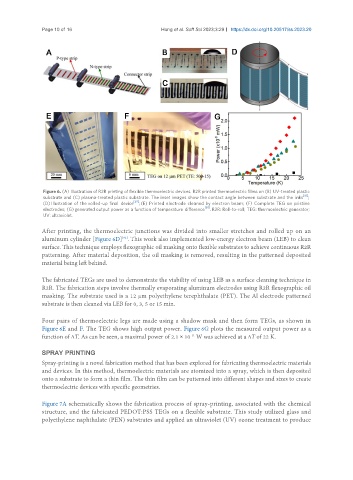
                Figure 6. (A) Illustration of R2R printing of flexible thermoelectric devices. R2R printed thermoelectric films on (B) UV-treated plastic
                substrate and (C) plasma-treated plastic substrate. The inset images show the contact angle between substrate and the  inks [91] ;
                (D) Illustration of the rolled-up final  device [92] ; (E) Printed electrode cleaned by electron beam; (F) Complete TEG on pristine
                electrodes; (G) generated output power as a function of temperature  difference [93] . R2R: Roll-to-roll; TEG: thermoelectric generator;
                UV: ultraviolet.

               After printing, the thermoelectric junctions was divided into smaller stretches and rolled up on an
               aluminum cylinder [Figure 6D] . This work also implemented low-energy electron beam (LEB) to clean
                                          [92]
               surface. This technique employs flexographic oil masking onto flexible substrates to achieve continuous R2R
               patterning. After material deposition, the oil masking is removed, resulting in the patterned deposited
               material being left behind.


               The fabricated TEGs are used to demonstrate the viability of using LEB as a surface cleaning technique in
               R2R. The fabrication steps involve thermally evaporating aluminum electrodes using R2R flexographic oil
               masking. The substrate used is a 12 µm polyethylene terephthalate (PET). The Al electrode patterned
               substrate is then cleaned via LEB for 0, 3, 5 or 15 min.


               Four pairs of thermoelectric legs are made using a shadow mask and then form TEGs, as shown in
               Figure 6E and F. The TEG shows high output power. Figure 6G plots the measured output power as a
               function of ΔT. As can be seen, a maximal power of 2.1 × 10  W was achieved at a ΔT of 22 K.
                                                                 -11

               SPRAY PRINTING
               Spray-printing is a novel fabrication method that has been explored for fabricating thermoelectric materials
               and devices. In this method, thermoelectric materials are atomized into a spray, which is then deposited
               onto a substrate to form a thin film. The thin film can be patterned into different shapes and sizes to create
               thermoelectric devices with specific geometries.

               Figure 7A schematically shows the fabrication process of spray-printing, associated with the chemical
               structure, and the fabricated PEDOT:PSS TEGs on a flexible substrate. This study utilized glass and
               polyethylene naphthalate (PEN) substrates and applied an ultraviolet (UV) ozone treatment to produce

