


Page 17 - Read Online
P. 17
Page 14 of 39                          Yang et al. Soft Sci. 2025, 5, 46  https://dx.doi.org/10.20517/ss.2025.44

               be solved by systematically integrating the scattering parameters into the classical framework, thereby
               improving the prediction accuracy and extending the applicability of the law to complex real systems [135,136] .

               Optical sensors based on the optical loss principle have the advantages of being simple, easy to operate, and
                         [137]
               inexpensive . However, since these sensors rely completely on optical loss, any fluctuations in optical loss
               due to fluctuations in the light source or other non-investigative factors will affect the stability and accuracy
                          [138]
               of the sensor .

               Fluorescence-based sensing
               Fluorescence sensing technology uses fluorescence signals to detect various substances. It is widely used in
               chemical analysis, biomedicine, and environmental monitoring. The basic principle is that certain
               substances (usually fluorescent probes or molecules) emit fluorescence at a specific wavelength when
               irradiated by an external excitation light source (e.g., UV or visible light) . The intensity, wavelength, and
                                                                             [139]
               lifetime of the fluorescence signals can reflect the concentration, characteristics, and existence of the
               substance under test.

               Fluorescence optical fiber sensing is an innovative application that combines fluorescence sensing and
               optical fiber technology and is widely used in many fields, such as biomedicine, environmental monitoring,
               and industrial process control. By combining fluorescent probes with optical fiber technology, high-
               sensitivity, long-distance, real-time monitoring can be achieved while avoiding the limitations of traditional
               sensors (e.g., the need for direct contact with the sample) . In the biomedical field, fluorescent optical
                                                                 [140]
               fiber sensing technology has many unique advantages and can be efficiently used in a variety of areas, such
               as disease diagnosis, molecular labeling, cellular imaging, and real-time monitoring. Fluorescent optical
               fiber sensors can be used to extract rich information from different features of fluorescence signals (e.g., the
               fluorescence intensity, wavelength, and lifetime), and these distinct methods of fluorescence data analysis
               may provide diverse diagnostic tools for biomedical applications.


               Currently, most reported flexible fluorescent optical fiber sensors mainly utilize fluorescence intensity
               demodulation. Analysis of the fluorescence intensity is the most common way of analyzing fluorescence
               data, quantifying the concentration of a target substance, or detecting the presence of a biomarker by
               measuring the intensity of light emitted by a probe molecule upon excitation. The fluorescence intensity is
               proportional to the concentration of fluorescent molecules in a sample and is therefore widely used for
               quantitative analysis. For example, in tumor marker detection, fluorescent optical fiber sensors combined
               with specific fluorescent probes can be used to detect trace amounts of tumor markers (such as
               carcinoembryonic antigen) in blood or tissues and to assess the presence and concentration of tumors
               through changes in the fluorescence intensity. In cellular analysis, when monitoring changes in the internal
               environment of cells (e.g., calcium ion concentration and pH changes), changes in the fluorescence intensity
               can reflect the cellular status in real time, providing information for early diagnosis of diseases.

               Measuring the absolute fluorescence intensity is a straightforward analysis method, but this method can be
               influenced by variations in the laser excitation power and other environmental factors. Consequently, the
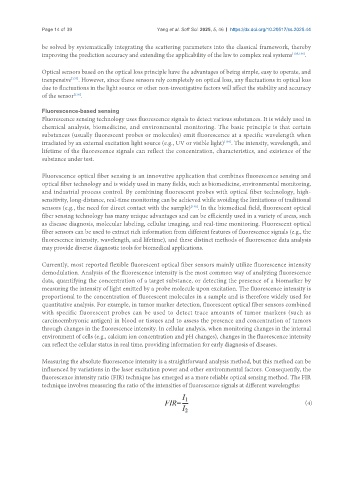
               fluorescence intensity ratio (FIR) technique has emerged as a more reliable optical sensing method. The FIR
               technique involves measuring the ratio of the intensities of fluorescence signals at different wavelengths:


                                                                                                        (4)

