


Page 21 - Read Online
P. 21
Page 18 of 39                          Yang et al. Soft Sci. 2025, 5, 46  https://dx.doi.org/10.20517/ss.2025.44

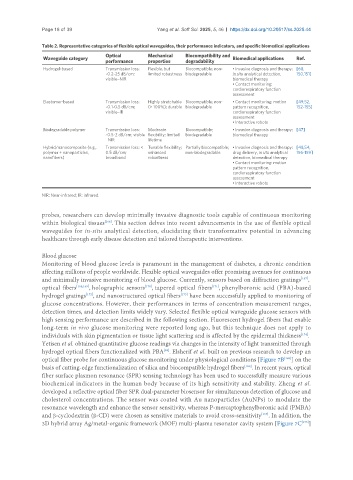
               Table 2. Representative categories of flexible optical waveguides, their performance indicators, and specific biomedical applications
                                     Optical       Mechanical   Biocompatibility and
                Waveguide category                                             Biomedical applications  Ref.
                                     performance   properties   degradability
                Hydrogel-based       Transmission loss:   Flexible, but   Biocompatible; non-  • Invasive diagnosis and therapy:  [68,
                                     ~0.2-25 dB/cm;   limited robustness biodegradable  in situ analytical detection,   150,151]
                                     visible–NIR                               biomedical therapy
                                                                               • Contact monitoring:
                                                                               cardiorespiratory function
                                                                               assessment
                Elastomer-based      Transmission loss:   Highly stretchable  Biocompatible; non-  • Contact monitoring: motion   [49,52,
                                     ~0.1-0.5 dB/cm;   (> 100%); durable biodegradable  pattern recognition,   152-155]
                                     visible–IR                                cardiorespiratory function
                                                                               assessment
                                                                               • Interactive robots
                Biodegradable polymer  Transmission loss:   Moderate   Biocompatible;   • Invasive diagnosis and therapy:  [47]
                                     ~0.5-2 dB/cm; visible flexibility; limited   biodegradable  biomedical therapy
                                     –NIR          lifetime
                Hybrid/nanocomposite (e.g.,   Transmission loss: <  Tunable flexibility;  Partially biocompatible;  • Invasive diagnosis and therapy:  [48,54,
                polymer + nanoparticles,   0.5 dB/cm;   enhanced   non-biodegradable  drug delivery, in situ analytical   156-159]
                nanofibers)          broadband     robustness                  detection, biomedical therapy
                                                                               • Contact monitoring: motion
                                                                               pattern recognition,
                                                                               cardiorespiratory function
                                                                               assessment
                                                                               • Interactive robots

               NIR: Near-infrared; IR: infrared.

               probes, researchers can develop minimally invasive diagnostic tools capable of continuous monitoring
                                    [166]
               within biological tissues . This section delves into recent advancements in the use of flexible optical
               waveguides for in-situ analytical detection, elucidating their transformative potential in advancing
               healthcare through early disease detection and tailored therapeutic interventions.

               Blood glucose
               Monitoring of blood glucose levels is paramount in the management of diabetes, a chronic condition
               affecting millions of people worldwide. Flexible optical waveguides offer promising avenues for continuous
               and minimally invasive monitoring of blood glucose. Currently, sensors based on diffraction gratings ,
                                                                                                      [167]
                                                  [170]
               optical fibers [168,169] , holographic sensors , tapered optical fibers , phenylboronic acid (PBA)-based
                                                                        [171]
               hydrogel gratings , and nanostructured optical fibers  have been successfully applied to monitoring of
                                                              [173]
                              [172]
               glucose concentrations. However, their performances in terms of concentration measurement ranges,
               detection times, and detection limits widely vary. Selected flexible optical waveguide glucose sensors with
               high sensing performance are described in the following section. Fluorescent hydrogel fibers that enable
               long-term in vivo glucose monitoring were reported long ago, but this technique does not apply to
               individuals with skin pigmentation or tissue light scattering and is affected by the epidermal thickness .
                                                                                                      [174]
               Yetisen et al. obtained quantitative glucose readings via changes in the intensity of light transmitted through
               hydrogel optical fibers functionalized with PBA . Elsherif et al. built on previous research to develop an
                                                        [68]
               optical fiber probe for continuous glucose monitoring under physiological conditions [Figure 7B ] on the
                                                                                                 [168]
               basis of cutting-edge functionalization of silica and biocompatible hydrogel fibers . In recent years, optical
                                                                                   [168]
               fiber surface plasmon resonance (SPR) sensing technology has been used to successfully measure various
               biochemical indicators in the human body because of its high sensitivity and stability. Zheng et al.
               developed a reflective optical fiber SPR dual-parameter biosensor for simultaneous detection of glucose and
               cholesterol concentrations. The sensor was coated with Au nanoparticles (AuNPs) to modulate the
               resonance wavelength and enhance the sensor sensitivity, whereas P-mercaptophenylboronic acid (PMBA)
               and β-cyclodextrin (β-CD) were chosen as sensitive materials to avoid cross-sensitivity . In addition, the
                                                                                         [157]
               3D hybrid array Ag/metal-organic framework (MOF) multi-plasma resonator cavity system [Figure 7C ]
                                                                                                       [175]

