


Page 26 - Read Online
P. 26
Yang et al. Soft Sci. 2025, 5, 46  https://dx.doi.org/10.20517/ss.2025.44       Page 23 of 39


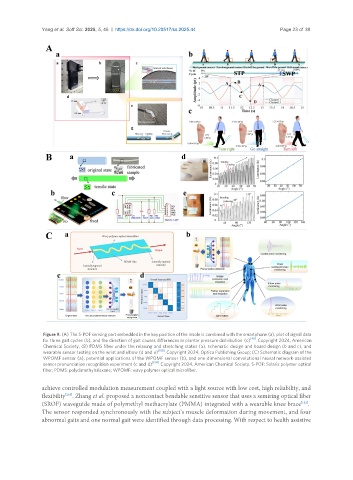
                Figure 9. (A) The S-POF sensing part embedded in the key position of the insole is combined with the smartphone (a), plot of signal data
                                                                                     [49]
                for three gait cycles (b), and the direction of gait causes differences in plantar pressure distribution (c)  . Copyright 2024, American
                Chemical Society; (B) PDMS fiber under the relaxing and stretching states (a), schematic design and board design (b and c), and
                wearable sensor testing on the wrist and elbow (d and  e) [158] . Copyright 2024, Optica Publishing Group; (C) Schematic diagram of the
                WPOMF sensor (a), potential applications of the WPOMF sensor (b), and one-dimensional convolutional neural network-assisted
                sensor pronunciation recognition experiment (c and d) [154] . Copyright 2024, American Chemical Society. S-POF: Solaris polymer optical
                fiber; PDMS: polydimethylsiloxane; WPOMF: wavy polymer optical microfiber.

               achieve controlled modulation measurement coupled with a light source with low cost, high reliability, and
                       [203]
               flexibility . Zhang et al. proposed a noncontact bendable sensitive sensor that uses a semiring optical fiber
               (SROF) waveguide made of polymethyl methacrylate (PMMA) integrated with a wearable knee brace .
                                                                                                      [152]
               The sensor responded synchronously with the subject’s muscle deformation during movement, and four
               abnormal gaits and one normal gait were identified through data processing. With respect to health assistive

