


Page 31 - Read Online
P. 31
Page 28 of 39                          Yang et al. Soft Sci. 2025, 5, 46  https://dx.doi.org/10.20517/ss.2025.44


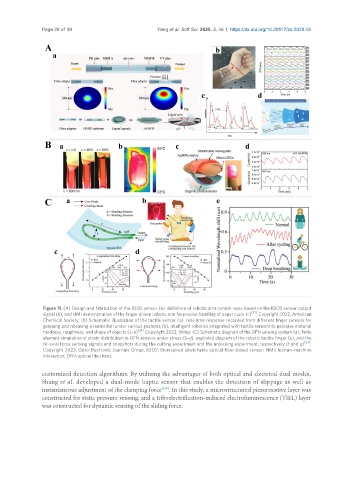
                Figure 11. (A) Design and fabrication of the BSOS sensor (a), definition of robotic arm control rules based on the BSOS sensor output
                                                                                      [52]
                signal (b), and HMI demonstration of the finger-driven robotic arm for precise handling of paper cups (c)  . Copyright 2022, American
                Chemical Society; (B) Schematic illustration of the tactile sensor (a), real-time response recorded from different finger sensors for
                grasping and releasing a tennis ball under various gestures (b), intelligent robotics integrated with tactile sensors to perceive material
                                                [54]
                hardness, roughness, and shape of objects (c-e)  . Copyright 2023, Wiley; (C) Schematic diagram of the OFN sensing system (a), finite
                element simulation of strain distribution in OFN sensors under stress (b-d), exploded diagram of the robotic tactile finger (e), and the
                tri-axial force sensing signals and snapshots during the cutting experiment and the unlocking experiment, respectively (f and  g) [53] .
                Copyright 2023, Opto-Electronic Journals Group. BSOS: Bioinspired stretchable optical fiber-based sensor; HMI: human–machine
                interaction; OFN: optical fiber knot.

               customized detection algorithms. By utilizing the advantages of both optical and electrical dual modes,
               Shang et al. developed a dual-mode haptic sensor that enables the detection of slippage as well as
                                                       [228]
               instantaneous adjustment of the clamping force . In this study, a microstructured piezoresistive layer was
               constructed for static pressure sensing, and a triboelectrification-induced electroluminescence (TIEL) layer
               was constructed for dynamic sensing of the sliding force.

