


Page 24 - Read Online
P. 24
Yang et al. Soft Sci. 2025, 5, 46  https://dx.doi.org/10.20517/ss.2025.44       Page 21 of 39


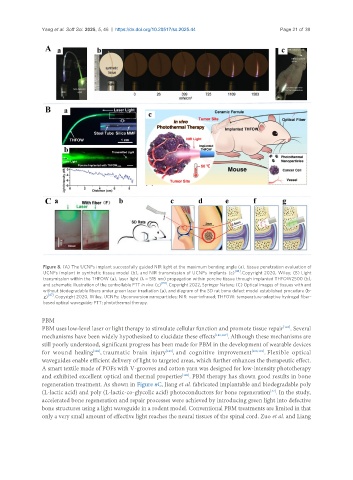
                Figure 8. (A) The UCNPs implant successfully guided NIR light at the maximum bending angle (a), tissue penetration evaluation of
                UCNPs implant in synthetic tissue model (b), and NIR transmission of UCNPs implants  (c) [48] . Copyright 2020, Wiley; (B) Light
                transmission within the THFOW (a), laser light (λ = 515 nm) propagation within porcine tissue through implanted THFOW2500 (b),
                and schematic illustration of the controllable PTT in vivo (c) [151] . Copyright 2022, Springer Nature; (C) Optical images of tissues with and
                without biodegradable fibers under green laser irradiation (a), and diagram of the SD rat bone defect model established procedure (b-
                g) [47] . Copyright 2020, Wiley. UCNPs: Upconversion nanoparticles; NIR: near-infrared; THFOW: temperature-adaptive hydrogel fiber-
                based optical waveguide; PTT: photothermal therapy.


               PBM
               PBM uses low-level laser or light therapy to stimulate cellular function and promote tissue repair . Several
                                                                                                 [185]
               mechanisms have been widely hypothesized to elucidate these effects [186,187] . Although these mechanisms are
               still poorly understood, significant progress has been made for PBM in the development of wearable devices
               for  wound  healing , traumatic  brain  injury , and  cognitive  improvement [190,191] . Flexible  optical
                                                         [189]
                                [188]
               waveguides enable efficient delivery of light to targeted areas, which further enhances the therapeutic effect.
               A smart textile made of POFs with V-grooves and cotton yarn was designed for low-intensity phototherapy
                                                              [192]
               and exhibited excellent optical and thermal properties . PBM therapy has shown good results in bone
               regeneration treatment. As shown in Figure 8C, Jiang et al. fabricated implantable and biodegradable poly
                                                                                            [47]
               (L-lactic acid) and poly (L-lactic-co-glycolic acid) photoconductors for bone regeneration . In the study,
               accelerated bone regeneration and repair processes were achieved by introducing green light into defective
               bone structures using a light waveguide in a rodent model. Conventional PBM treatments are limited in that
               only a very small amount of effective light reaches the neural tissues of the spinal cord. Zuo et al. and Liang

