


Page 18 - Read Online
P. 18
Yang et al. Soft Sci. 2025, 5, 46  https://dx.doi.org/10.20517/ss.2025.44       Page 15 of 39

               where I  and I  are the fluorescence intensities of two probes at different wavelengths. Typically, this method
                     1
                           2
               employs two different fluorescent probes, each of which emits a fluorescence signal at a distinct wavelength
               after being excited . These probes are specifically chosen so that each fluorescence signal responds
                                [141]
               differently to the target substance being measured.

               The FIR method reduces the effect of external interference, reduces the dependence on the probe
               concentration, increases the sensitivity and resolution, etc. Li et al. hydrophobically modified a pH-sensitive
               ratiometric fluorescent probe with a sol-gel material and physically encapsulated it on the surface of an
               optical fiber with an antibleaching agent . The 8-hydroxy-1,3,6-styrene trisulfonic acid (HPTS) used in
                                                  [142]
               this study has two excitation bands near 375 and 450 nm that exhibit different pH dependences, making it
               suitable for use in the FIR method to monitor the pH to confirm the boundaries of cancer cells. In addition,
               by modifying multiple indicators on the fiber surface, multiple biomarkers can also be simultaneously
               monitored, reducing cross-sensitivity .
                                              [143]

               Spectrum-based sensing
               Spectrum-based optical sensing relies on analyzing the spectral properties of light after its interactions with
               a target medium, such as reflection, scattering, and interference, to extract spectral information related to
               specific external parameters or medium properties. This principle is widely used in a variety of flexible
               optical waveguide sensors, including those based on fiber Bragg gratings (FBGs) and interference sensors.


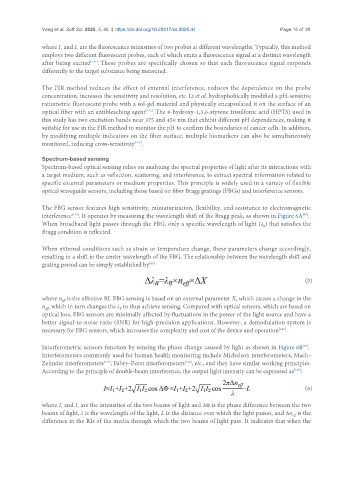
               The FBG sensor features high sensitivity, miniaturization, flexibility, and resistance to electromagnetic
                                                                                                       [55]
                         [144]
               interference . It operates by measuring the wavelength shift of the Bragg peak, as shown in Figure 6A .
               When broadband light passes through the FBG, only a specific wavelength of light (λ ) that satisfies the
                                                                                          B
               Bragg condition is reflected.
               When external conditions such as strain or temperature change, these parameters change accordingly,
               resulting in a shift in the center wavelength of the FBG. The relationship between the wavelength shift and
               grating period can be simply established by [40]

                                                                                                        (5)


               where n  is the effective RI. FBG sensing is based on an external parameter X, which causes a change in the
                      eff
               n , which in turn changes the λ  to thus achieve sensing. Compared with optical sensors, which are based on
                eff
                                         B
               optical loss, FBG sensors are minimally affected by fluctuations in the power of the light source and have a
               better signal-to-noise ratio (SNR) for high-precision applications. However, a demodulation system is
                                                                                               [145]
               necessary for FBG sensors, which increases the complexity and cost of the device and operation .
               Interferometric sensors function by sensing the phase change caused by light as shown in Figure 6B .
                                                                                                       [37]
               Interferometers commonly used for human health monitoring include Michelson interferometers, Mach–
                                    [147]
                                                               [148]
               Zehnder interferometers , Fabry–Perot interferometers , etc., and they have similar working principles.
               According to the principle of double-beam interference, the output light intensity can be expressed as :
                                                                                                    [149]
                                                                                                        (6)

               where I  and I  are the intensities of the two beams of light and ΔΦ is the phase difference between the two
                      1
                           2
               beams of light, λ is the wavelength of the light, L is the distance over which the light passes, and Δn  is the
                                                                                                    eff
               difference in the RIs of the media through which the two beams of light pass. It indicates that when the

