


Page 13 - Read Online
P. 13
Page 10 of 39                          Yang et al. Soft Sci. 2025, 5, 46  https://dx.doi.org/10.20517/ss.2025.44

               Biodegradable polymers
               Biodegradable polymers are a promising class of materials for flexible optical waveguides used in health-
               related applications, offering the dual benefits of sustainability and biocompatibility. These polymers are
               designed to naturally degrade over time, reducing the long-term environmental impact and minimizing the
               need for removal or disposal. In the context of human health assistance, biodegradable polymers are
               beneficial for short-term biomedical applications, such as implantable medical devices, tissue scaffolds, and
               biodegradable sensors, for which gradual degradation after use is desirable.

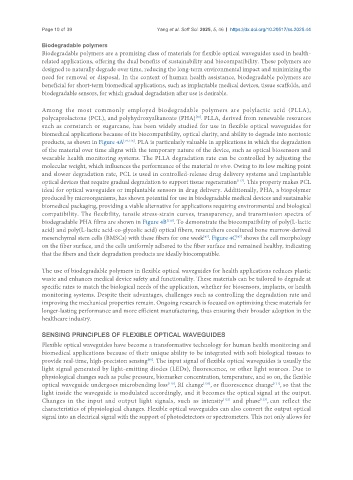
               Among  the  most  commonly  employed  biodegradable  polymers  are  polylactic  acid  (PLLA),
               polycaprolactone (PCL), and polyhydroxyalkanoate (PHA) . PLLA, derived from renewable resources
                                                                   [60]
               such as cornstarch or sugarcane, has been widely studied for use in flexible optical waveguides for
               biomedical applications because of its biocompatibility, optical clarity, and ability to degrade into nontoxic
               products, as shown in Figure 4A [79,116] . PLA is particularly valuable in applications in which the degradation
               of the material over time aligns with the temporary nature of the device, such as optical biosensors and
               wearable health monitoring systems. The PLLA degradation rate can be controlled by adjusting the
               molecular weight, which influences the performance of the material in vivo. Owing to its low melting point
               and slower degradation rate, PCL is used in controlled-release drug delivery systems and implantable
                                                                                 [117]
               optical devices that require gradual degradation to support tissue regeneration . This property makes PCL
               ideal for optical waveguides or implantable sensors in drug delivery. Additionally, PHA, a biopolymer
               produced by microorganisms, has shown potential for use in biodegradable medical devices and sustainable
               biomedical packaging, providing a viable alternative for applications requiring environmental and biological
               compatibility. The flexibility, tensile stress-strain curves, transparency, and transmission spectra of
               biodegradable PHA films are shown in Figure 4B . To demonstrate the biocompatibility of poly(L-lactic
                                                         [118]
               acid) and poly(L-lactic acid-co-glycolic acid) optical fibers, researchers cocultured bone marrow-derived
                                                                      [47]
               mesenchymal stem cells (BMSCs) with these fibers for one week . Figure 4C  shows the cell morphology
                                                                                 [47]
               on the fiber surface, and the cells uniformly adhered to the fiber surface and remained healthy, indicating
               that the fibers and their degradation products are ideally biocompatible.

               The use of biodegradable polymers in flexible optical waveguides for health applications reduces plastic
               waste and enhances medical device safety and functionality. These materials can be tailored to degrade at
               specific rates to match the biological needs of the application, whether for biosensors, implants, or health
               monitoring systems. Despite their advantages, challenges such as controlling the degradation rate and
               improving the mechanical properties remain. Ongoing research is focused on optimizing these materials for
               longer-lasting performance and more efficient manufacturing, thus ensuring their broader adoption in the
               healthcare industry.


               SENSING PRINCIPLES OF FLEXIBLE OPTICAL WAVEGUIDES
               Flexible optical waveguides have become a transformative technology for human health monitoring and
               biomedical applications because of their unique ability to be integrated with soft biological tissues to
               provide real-time, high-precision sensing . The input signal of flexible optical waveguides is usually the
                                                   [60]
               light signal generated by light-emitting diodes (LEDs), fluorescence, or other light sources. Due to
               physiological changes such as pulse pressure, biomarker concentration, temperature, and so on, the flexible
               optical waveguide undergoes microbending loss , RI change , or fluorescence change , so that the
                                                                      [120]
                                                                                             [121]
                                                          [119]
               light inside the waveguide is modulated accordingly, and it becomes the optical signal at the output.
                                                                            [122]
               Changes  in  the  input  and  output  light  signals,  such  as  intensity   and  phase , can  reflect  the
                                                                                         [123]
               characteristics of physiological changes. Flexible optical waveguides can also convert the output optical
               signal into an electrical signal with the support of photodetectors or spectrometers. This not only allows for

