


Page 12 - Read Online
P. 12
Yang et al. Soft Sci. 2025, 5, 46  https://dx.doi.org/10.20517/ss.2025.44        Page 9 of 39


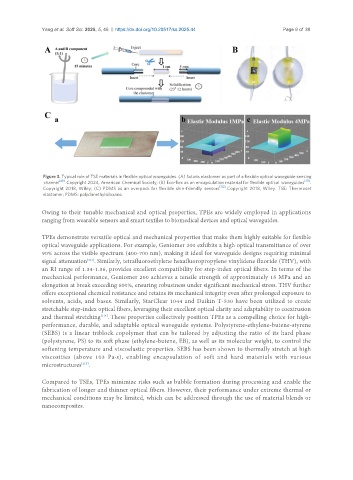
                Figure 3. Typical role of TSE materials in flexible optical waveguides. (A) Solaris elastomer as part of a flexible optical waveguide sensing
                channel [49] . Copyright 2024, American Chemical Society; (B) Eco-flex as an encapsulation material for flexible optical  waveguides [111] .
                Copyright 2018, Wiley; (C) PDMS as an overpack for flexible skin-friendly  sensors [112] . Copyright 2018, Wiley. TSE: Thermoset
                elastomer; PDMS: polydimethylsiloxane.


               Owing to their tunable mechanical and optical properties, TPEs are widely employed in applications
               ranging from wearable sensors and smart textiles to biomedical devices and optical waveguides.

               TPEs demonstrate versatile optical and mechanical properties that make them highly suitable for flexible
               optical waveguide applications. For example, Geniomer 200 exhibits a high optical transmittance of over
               90% across the visible spectrum (400-700 nm), making it ideal for waveguide designs requiring minimal
               signal attenuation . Similarly, tetrafluoroethylene hexafluoropropylene vinylidene fluoride (THV), with
                              [113]
               an RI range of 1.34-1.36, provides excellent compatibility for step-index optical fibers. In terms of the
               mechanical performance, Geniomer 200 achieves a tensile strength of approximately 15 MPa and an
               elongation at break exceeding 600%, ensuring robustness under significant mechanical stress. THV further
               offers exceptional chemical resistance and retains its mechanical integrity even after prolonged exposure to
               solvents, acids, and bases. Similarly, StarClear 1044 and Daikin T-530 have been utilized to create
               stretchable step-index optical fibers, leveraging their excellent optical clarity and adaptability to coextrusion
                                   [114]
               and thermal stretching . These properties collectively position TPEs as a compelling choice for high-
               performance, durable, and adaptable optical waveguide systems. Polystyrene-ethylene-butene-styrene
               (SEBS) is a linear triblock copolymer that can be tailored by adjusting the ratio of its hard phase
               (polystyrene, PS) to its soft phase (ethylene-butene, EB), as well as its molecular weight, to control the
               softening temperature and viscoelastic properties. SEBS has been shown to thermally stretch at high
               viscosities  (above  103  Pa·s),  enabling  encapsulation  of  soft  and  hard  materials  with  various
                            [115]
               microstructures .

               Compared to TSEs, TPEs minimize risks such as bubble formation during processing and enable the
               fabrication of longer and thinner optical fibers. However, their performance under extreme thermal or
               mechanical conditions may be limited, which can be addressed through the use of material blends or
               nanocomposites.

