


Page 16 - Read Online
P. 16
Yang et al. Soft Sci. 2025, 5, 46  https://dx.doi.org/10.20517/ss.2025.44       Page 13 of 39


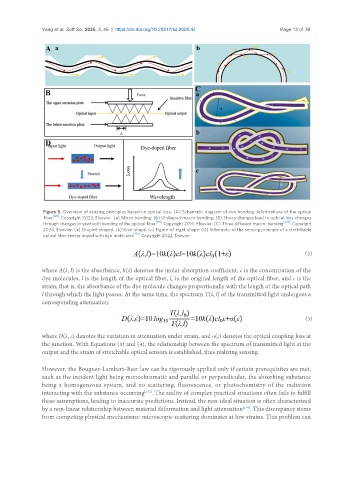
                Figure 5. Overview of sensing principles based on optical loss. (A) Schematic diagram of two bending deformations of the optical
                fiber [126] . Copyright 2023, Elsevier. (a) Micro-bending. (b) U-shaped macro-bending; (B) Stress changes lead to optical loss changes
                through changes in sawtooth bending of the optical fiber [119] . Copyright 2016, Elsevier; (C) Three different macro-bending [130] . Copyright
                2024, Elsevier. (a) Droplet-shaped. (b) Knot shape. (c) Figure-of-eight shape; (D) Schematic of the sensing principle of a stretchable
                optical fiber sensor doped with dye molecules [131] . Copyright 2022, Elsevier.

                                                                                                        (2)


               where A(λ, l) is the absorbance, k(λ) denotes the molar absorption coefficient, c is the concentration of the
               dye molecules, l is the length of the optical fiber, l  is the original length of the optical fiber, and ε is the
                                                           0
               strain; that is, the absorbance of the dye molecule changes proportionally with the length of the optical path
               l through which the light passes. At the same time, the spectrum T(λ, l) of the transmitted light undergoes a
               corresponding attenuation:

                                                                                                        (3)


               where D(λ, ε) denotes the variation in attenuation under strain, and α(ε) denotes the optical coupling loss at
               the junction. With Equations (3) and (4), the relationship between the spectrum of transmitted light at the
               output and the strain of stretchable optical sensors is established, thus realizing sensing.


               However, the Bouguer–Lambert–Beer law can be rigorously applied only if certain prerequisites are met,
               such as the incident light being monochromatic and parallel or perpendicular, the absorbing substance
               being a homogeneous system, and no scattering, fluorescence, or photochemistry of the radiation
                                                  [133]
               interacting with the substance occurring . The reality of complex practical situations often fails to fulfill
               these assumptions, leading to inaccurate predictions. Instead, the non-ideal situation is often characterized
                                                                                   [134]
               by a non-linear relationship between material deformation and light attenuation . This discrepancy stems
               from competing physical mechanisms: microscopic scattering dominates at low strains. This problem can

