


Page 7 - Read Online
P. 7
Yang et al. Soft Sci. 2025, 5, 46  https://dx.doi.org/10.20517/ss.2025.44                                                  Page 5 of 39

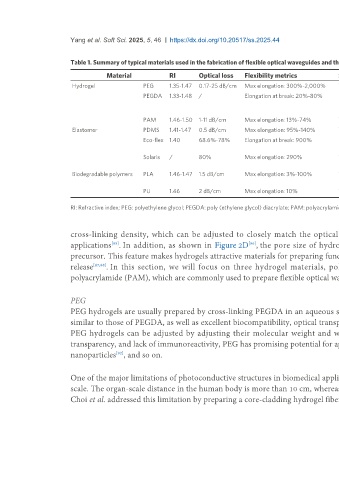
                   Table 1. Summary of typical materials used in the fabrication of flexible optical waveguides and their relevant properties
                           Material        RI     Optical loss  Flexibility metrics  Structural metrics      Other properties                     Ref.
                   Hydrogel          PEG   1.35-1.47  0.17-25 dB/cm  Max elongation: 300%-2,000%  Young’s modulus: 1-44 kPa  Nontoxic             [61-64]
                                     PEGDA  1.33-1.48  /      Elongation at break: 20%-80%  Elastic modulus: 30 kPa - 85 MPa  Tensile strength: 1.5-4.0 MPa (highly cross-linked);   [65-67]
                                                                                                             36 kPa -20 MPa (composite)
                                                                                                             Nontoxic
                                     PAM   1.46-1.50  1-11 dB/cm  Max elongation: 13%-74%  Young’s modulus: 20-27 MPa  /                          [68]
                   Elastomer         PDMS  1.41-1.47  0.5 dB/cm  Max elongation: 95%-140%  Young’s modulus: 0.57-3.7 MPa  /                       [69-74]
                                     Eco-flex 1.40  68.6%-78%  Elongation at break: 900%  Shear modulus: 1.3-35 kPa  Tensile strength: 200 psi    [75-77]
                                                                                                             Shore hardness: 00-30
                                     Solaris  /   80%         Max elongation: 290%   Young’s modulus: 1.08 MPa   Shore A hardness: 15             [75,78]
                                                                                     Shear modulus: 0.6-175 kPa  Tensile strength: 180 psi
                   Biodegradable polymers  PLA  1.46-1.47  1.5 dB/cm  Max elongation: 3%-100%  Young’s modulus: 2.7-7 GPa  Biodegradation speed: 1 week to 4 months   [79-81]
                                                                                                             Nonelastic
                                     PU    1.46   2 dB/cm     Max elongation: 10%    Young’s modulus: 0.3 MPa  /                                  [82]

                   RI: Refractive index; PEG: polyethylene glycol; PEGDA: poly (ethylene glycol) diacrylate; PAM: polyacrylamide; PDMS: polydimethylsiloxane; PLA: polylactide; PU: polyurethane.


                   cross-linking density, which can be adjusted to closely match the optical and mechanical properties of soft tissues for a wide range of biomedical
                                                               [86]
                   applications . In addition, as shown in Figure 2D , the pore size of hydrogels can be controlled by changing the relevant properties of the polymer
                             [85]
                   precursor. This feature makes hydrogels attractive materials for preparing functional biophotonic waveguides that provide drug delivery and controlled drug
                   release [87,88] . In this section, we will focus on three hydrogel materials, polyethylene glycol (PEG), poly (ethylene glycol) diacrylate (PEGDA), and
                   polyacrylamide (PAM), which are commonly used to prepare flexible optical waveguides for human health.


                   PEG
                   PEG hydrogels are usually prepared by cross-linking PEGDA in an aqueous solution and have antifouling properties or anti-protein-adsorption properties
                   similar to those of PEGDA, as well as excellent biocompatibility, optical transparency, no immunoreactivity, etc. . The mechanical and optical properties of
                                                                                                                  [85]
                                                                                                [89]
                   PEG hydrogels can be adjusted by adjusting their molecular weight and water content . In addition, owing to its excellent biocompatibility, optical
                                                                                                                                      [91]
                                                                                                                    [90]
                   transparency, and lack of immunoreactivity, PEG has promising potential for applications in the fields of biosensing , tissue engineering , surface coating of
                              [92]
                   nanoparticles , and so on.
                   One of the major limitations of photoconductive structures in biomedical applications is that the effective light transmission distance is smaller than the organ
                   scale. The organ-scale distance in the human body is more than 10 cm, whereas the 1/e attenuation range of waveguides is no more than a few centimeters .
                                                                                                                                                     [93]
                   Choi et al. addressed this limitation by preparing a core-cladding hydrogel fiber with an overall step RI by the process depicted in Figure 2E(a) using 80%-90%

