


Page 94 - Read Online
P. 94
Zhou et al. Soft Sci. 2026, 6, 10                                                 Page 31 of 47


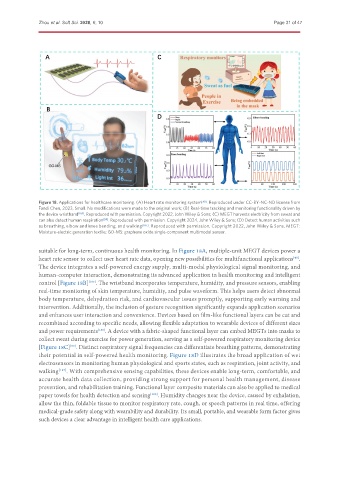
               Figure 18. Applications for healthcare monitoring. (A) Heart rate monitoring system [48] . Reproduced under CC-BY-NC-ND license from
               Fandi Chen, 2023, Small. No modifications were made to the original work; (B) Real-time tracking and monitoring functionality driven by
               the device wristband [185] . Reproduced with permission. Copyright 2022, John Wiley & Sons; (C) MEGT harvests electricity from sweat and
               can also detect human respiration [59] . Reproduced with permission. Copyright 2024, John Wiley & Sons; (D) Detect human activities such
               as breathing, elbow and knee bending, and walking [187] . Reproduced with permission. Copyright 2022, John Wiley & Sons. MEGT:
               Moisture-electric generation textile; GO-MS: graphene oxide single-component multimodal sensor.


               suitable for long-term, continuous health monitoring. In Figure 18A, multiple-unit MEGT devices power a
               heart rate sensor to collect user heart rate data, opening new possibilities for multifunctional applications .
                                                                                                        [48]
               The device integrates a self-powered energy supply, multi-modal physiological signal monitoring, and
               human-computer interaction, demonstrating its advanced application in health monitoring and intelligent
               control [Figure 18B] . The wristband incorporates temperature, humidity, and pressure sensors, enabling
                                [185]
               real-time monitoring of skin temperature, humidity, and pulse waveform. This helps users detect abnormal
               body temperature, dehydration risk, and cardiovascular issues promptly, supporting early warning and
               intervention. Additionally, the inclusion of gesture recognition significantly expands application scenarios
               and enhances user interaction and convenience. Devices based on film-like functional layers can be cut and
               recombined according to specific needs, allowing flexible adaptation to wearable devices of different sizes
               and power requirements . A device with a fabric-shaped functional layer can embed MEGTs into masks to
                                   [186]
               collect sweat during exercise for power generation, serving as a self-powered respiratory monitoring device
               [Figure 18C] . Distinct respiratory signal frequencies can differentiate breathing patterns, demonstrating
                          [59]
               their potential in self-powered health monitoring. Figure 18D illustrates the broad application of wet
               electrosensors in monitoring human physiological and sports states, such as respiration, joint activity, and
               walking [187] . With comprehensive sensing capabilities, these devices enable long-term, comfortable, and
               accurate health data collection, providing strong support for personal health management, disease
               prevention, and rehabilitation training. Functional layer composite materials can also be applied to medical
               paper towels for health detection and sensing [188] . Humidity changes near the device, caused by exhalation,
               allow the thin, foldable tissue to monitor respiratory rate, cough, or speech patterns in real time, offering
               medical-grade safety along with wearability and durability. Its small, portable, and wearable form factor gives
               such devices a clear advantage in intelligent health care applications.

