


Page 90 - Read Online
P. 90
Zhou et al. Soft Sci. 2026, 6, 10                                                 Page 27 of 47


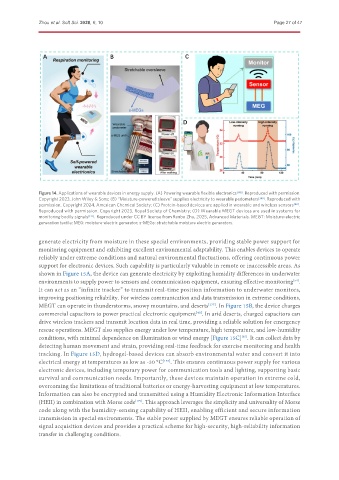
               Figure 14. Applications of wearable devices in energy supply. (A) Powering wearable flexible electronics [148] . Reproduced with permission.
               Copyright 2023, John Wiley & Sons; (B) “Moisture-powered sleeve” supplies electricity to wearable pedometers [149] . Reproduced with
               permission. Copyright 2024, American Chemical Society; (C) Protein-based devices are applied in wearable and wireless sensors [40] .
               Reproduced with permission. Copyright 2023, Royal Society of Chemistry; (D) Wearable MEGT devices are used in systems for
               monitoring bodily signals [137] . Reproduced under CC BY license from Renbo Zhu, 2025, Advanced Materials. MEGT: Moisture-electric
               generation textile; MEG: moisture-electric generator; s-MEGs: stretchable moisture electric generators.


               generate electricity from moisture in these special environments, providing stable power support for
               monitoring equipment and exhibiting excellent environmental adaptability. This enables devices to operate
               reliably under extreme conditions and natural environmental fluctuations, offering continuous power
               support for electronic devices. Such capability is particularly valuable in remote or inaccessible areas. As
               shown in Figure 15A, the device can generate electricity by exploiting humidity differences in underwater
               environments to supply power to sensors and communication equipment, ensuring effective monitoring .
                                                                                                        [54]
               It can act as an “infinite tracker” to transmit real-time position information to underwater monitors,
               improving positioning reliability. For wireless communication and data transmission in extreme conditions,
               MEGT can operate in thunderstorms, snowy mountains, and deserts [177] . In Figure 15B, the device charges
               commercial capacitors to power practical electronic equipment . In arid deserts, charged capacitors can
                                                                      [40]
               drive wireless trackers and transmit location data in real time, providing a reliable solution for emergency
               rescue operations. MEGT also supplies energy under low temperature, high temperature, and low-humidity
               conditions, with minimal dependence on illumination or wind energy [Figure 15C] . It can collect data by
                                                                                      [35]
               detecting human movement and strain, providing real-time feedback for exercise monitoring and health
               tracking. In Figure 15D, hydrogel-based devices can absorb environmental water and convert it into
               electrical energy at temperatures as low as -30 °C [178] . This ensures continuous power supply for various
               electronic devices, including temporary power for communication tools and lighting, supporting basic
               survival and communication needs. Importantly, these devices maintain operation in extreme cold,
               overcoming the limitations of traditional batteries or energy-harvesting equipment at low temperatures.
               Information can also be encrypted and transmitted using a Humidity Electronic Information Interface
               (HEII) in combination with Morse code . This approach leverages the simplicity and universality of Morse
                                                 [179]
               code along with the humidity-sensing capability of HEII, enabling efficient and secure information
               transmission in special environments. The stable power supplied by MEGT ensures reliable operation of
               signal acquisition devices and provides a practical scheme for high-security, high-reliability information
               transfer in challenging conditions.

