


Page 92 - Read Online
P. 92
Zhou et al. Soft Sci. 2026, 6, 10                                                 Page 29 of 47


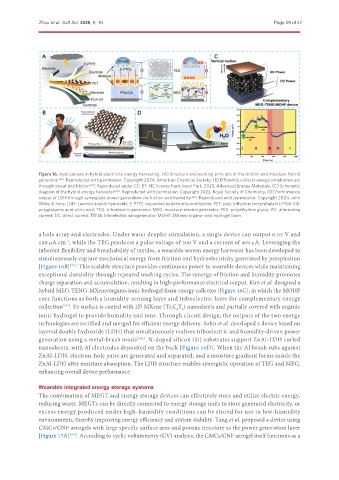
               Figure 16. Applications in hybrid electricity energy harvesting. (A) Structure and working principle of the friction and moisture hybrid
               generator [180] . Reproduced with permission. Copyright 2024, American Chemical Society; (B) Efficiently collects energy simultaneously
               through sweat and friction [42] . Reproduced under CC-BY-NC license from Jiwon Park, 2023, Advanced Energy Materials; (C) Schematic
               diagram of the hybrid energy harvester [181] . Reproduced with permission. Copyright 2023, Royal Society of Chemistry; (D) Performance
               output of LDH through synergistic power generation via friction and humidity [182] . Reproduced with permission. Copyright 2024, John
               Wiley & Sons. LDH: Layered double hydroxide; E-PTFE: expanded polytetrafluoroethylene; PET: poly (ethylene terephthalate); PGA-CA:
               polyglutamic acid-citric acid; TEG: triboelectric generator; MEG: moisture-electric generator; PEG: polyethylene glycol; AC: alternating
               current; DC: direct current; TENG: triboelectric nanogenerator; MOHF: MXene/organo-ionic hydrogel foam.

               a hole array and electrodes. Under water droplet stimulation, a single device can output 0.55 V and
               120 μA·cm , while the TEG produces a pulse voltage of 300 V and a current of 400 μA. Leveraging the
                        -2
               inherent flexibility and breathability of textiles, a wearable woven energy harvester has been developed to
               simultaneously capture mechanical energy from friction and hydroelectricity generated by perspiration
               [Figure 16B] . This scalable structure provides continuous power to wearable devices while maintaining
                          [42]
               exceptional durability through repeated washing cycles. The synergy of friction and humidity promotes
               charge separation and accumulation, resulting in high-performance electrical output. Kim et al. designed a
               hybrid MEG-TENG-MXene/organo-ionic hydrogel foam energy collector [Figure 16C], in which the MOHF
               core functions as both a humidity-sensing layer and triboelectric layer for complementary energy
               collection [181] . Its surface is coated with 2D MXene (Ti C T ) nanosheets and partially covered with organic
                                                               2 x
                                                             3
               ionic hydrogel to provide humidity and ions. Through circuit design, the outputs of the two energy
               technologies are rectified and merged for efficient energy delivery. Sohn et al. developed a device based on
               layered double hydroxide (LDH) that simultaneously realizes triboelectric and humidity-driven power
               generation using a metal-brush mode [182] . N-doped silicon (Si) substrates support ZnAl-LDH curled
               nanosheets, with Al electrodes deposited on the back [Figure 16D]. When the Al brush rubs against
               ZnAl-LDH, electron-hole pairs are generated and separated, and a moisture gradient forms inside the
               ZnAl-LDH after moisture absorption. The LDH structure enables synergistic operation of TEG and MEG,
               enhancing overall device performance.


               Wearable integrated energy storage systems
               The combination of MEGT and energy storage devices can effectively store and utilize electric energy,
               reducing waste. MEGTs can be directly connected to energy storage units to store generated electricity, or
               excess energy produced under high-humidity conditions can be stored for use in low-humidity
               environments, thereby improving energy efficiency and system stability. Tang et al. proposed a device using
               CMCs/CNF aerogels with large specific surface area and porous structure as the power generation layer
               [Figure 17A] . According to cyclic voltammetry (CV) analysis, the CMCs/CNF aerogel itself functions as a
                         [183]

