


Page 95 - Read Online
P. 95
Page 32 of 47                                                         Zhou et al. Soft Sci. 2026, 6, 10


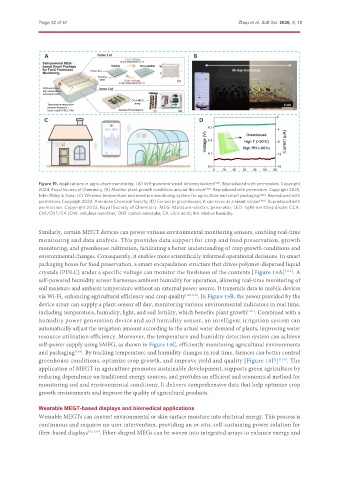
               Figure 19. Applications in agriculture monitoring. (A) Self-powered smart delivery lockers [161] . Reproduced with permission. Copyright
               2024, Royal Society of Chemistry; (B) Monitor plant growth conditions around the clock [191] . Reproduced with permission. Copyright 2025,
               John Wiley & Sons; (C) Wireless temperature and moisture monitoring system for agriculture and smart packaging [142] . Reproduced with
               permission. Copyright 2024, American Chemical Society; (D) For use in greenhouses, it can serve as a smart sensor [190] . Reproduced with
               permission. Copyright 2022, Royal Society of Chemistry. MEG: Moisture-electric generator; LED: light-emitting diode; CCA:
               CNF/CNT/CA (CNF: cellulose nanofiber; CNT: carbon nanotube; CA: citric acid); RH: relative humidity.


               Similarly, certain MEGT devices can power various environmental monitoring sensors, enabling real-time
               monitoring and data analysis. This provides data support for crop and food preservation, growth
               monitoring, and greenhouse cultivation, facilitating a better understanding of crop growth conditions and
               environmental changes. Consequently, it enables more scientifically informed operational decisions. In smart
               packaging boxes for food preservation, a smart encapsulation structure that drives polymer-dispersed liquid
               crystals (PDLC) under a specific voltage can monitor the freshness of the contents [Figure 19A] [161] . A
               self-powered humidity sensor harnesses ambient humidity for operation, allowing real-time monitoring of
               soil moisture and ambient temperature without an external power source. It transmits data to mobile devices
               via Wi-Fi, enhancing agricultural efficiency and crop quality [189,190] . In Figure 19B, the power provided by the
               device array can supply a plant sensor all day, monitoring various environmental indicators in real time,
               including temperature, humidity, light, and soil fertility, which benefits plant growth [191] . Combined with a
               humidity power generation device and soil humidity sensor, an intelligent irrigation system can
               automatically adjust the irrigation amount according to the actual water demand of plants, improving water
               resource utilization efficiency. Moreover, the temperature and humidity detection system can achieve
               self-power supply using SMEG, as shown in Figure 19C, efficiently monitoring agricultural environments
               and packaging [142] . By tracking temperature and humidity changes in real time, farmers can better control
               greenhouse conditions, optimize crop growth, and improve yield and quality [Figure 19D] [190] . The
               application of MEGT in agriculture promotes sustainable development, supports green agriculture by
               reducing dependence on traditional energy sources, and provides an efficient and economical method for
               monitoring soil and environmental conditions. It delivers comprehensive data that help optimize crop
               growth environments and improve the quality of agricultural products.


               Wearable MEGT-based displays and biomedical applications
               Wearable MEGTs can convert environmental or skin surface moisture into electrical energy. This process is
               continuous and requires no user intervention, providing an in-situ, self-sustaining power solution for
               fiber-based displays [92,130] . Fiber-shaped MEGs can be woven into integrated arrays to enhance energy and

