


Page 93 - Read Online
P. 93
Page 30 of 47                                                         Zhou et al. Soft Sci. 2026, 6, 10


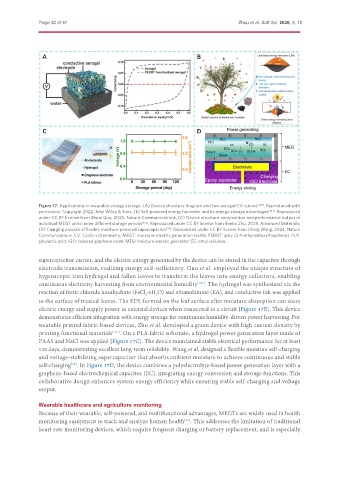
               Figure 17. Applications in wearable energy storage. (A) Device structure diagram and two aerogel CV curves [183] . Reproduced with
               permission. Copyright 2022, John Wiley & Sons; (B) Self-powered energy harvester and its energy storage advantages  [184] . Reproduced
               under CC BY license from Shuai Guo, 2025, Nature Communications; (C) Device structure composition and performance output of
               individual MEGT units under different storage periods [137] . Reproduced under CC BY license from Renbo Zhu, 2025, Advanced Materials;
               (D) Charging process of flexible moisture-powered supercapacitor [79] . Reproduced under CC BY license from Lifeng Wang, 2024, Nature
               Communications. CV: Cyclic voltammetry; MEGT: moisture-electric generation textile; PEDOT: poly (3,4-ethynedioxythiophene); PLA:
               polylactic acid; rGO: reduced graphene oxide; MEG: moisture-electric generator; EC: ethyl cellulose.


               supercapacitor carrier, and the electric energy generated by the device can be stored in the capacitor through
               electrode transmission, realizing energy self-sufficiency. Guo et al. employed the unique structure of
               hygroscopic iron hydrogel and fallen leaves to transform the leaves into energy collectors, enabling
               continuous electricity harvesting from environmental humidity [184] . The hydrogel was synthesized via the
               reaction of ferric chloride hexahydrate (FeCl ·6H O) and ethanolamine (EA), and conductive ink was applied
                                                        2
                                                    3
               to the surface of treated leaves. The EDL formed on the leaf surface after moisture absorption can store
               electric energy and supply power to external devices when connected to a circuit [Figure 17B]. This device
               demonstrates efficient integration with energy storage for continuous humidity-driven power harvesting. For
               wearable printed fabric-based devices, Zhu et al. developed a green device with high current density by
               printing functional materials [137] . On a PLA fabric substrate, a hydrogel power generation layer made of
               PAAS and NaCl was applied [Figure 17C]. The device maintained stable electrical performance for at least
               120 days, demonstrating excellent long-term reliability. Wang et al. designed a flexible moisture self-charging
               and voltage-stabilizing supercapacitor that absorbs ambient moisture to achieve continuous and stable
               self-charging . In Figure 17D, the device combines a polyelectrolyte-based power generation layer with a
                          [79]
               graphene-based electrochemical capacitor (EC), integrating energy conversion and storage functions. This
               collaborative design enhances system energy efficiency while ensuring stable self-charging and voltage
               output.


               Wearable healthcare and agriculture monitoring
               Because of their wearable, self-powered, and multifunctional advantages, MEGTs are widely used in health
               monitoring equipment to track and analyze human health . This addresses the limitation of traditional
                                                                  [36]
               heart rate monitoring devices, which require frequent charging or battery replacement, and is especially

