


Page 85 - Read Online
P. 85
Page 22 of 47                                                         Zhou et al. Soft Sci. 2026, 6, 10


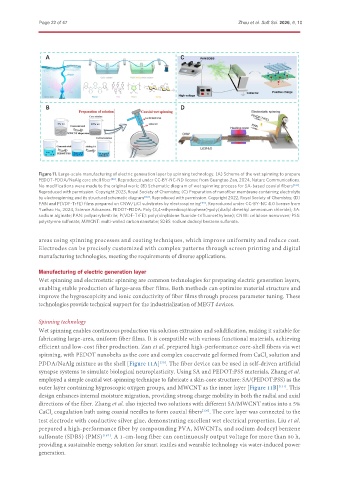
               Figure 11. Large-scale manufacturing of electric generation layer by spinning technology. (A) Scheme of the wet spinning to prepare
               PEDOT-PDDA/NaAlg core shell fiber [50] . Reproduced under CC-BY-NC-ND license from Guangtao Zan, 2024, Nature Communications.
               No modifications were made to the original work; (B) Schematic diagram of wet spinning process for SA-based coaxial fibers [131] .
               Reproduced with permission. Copyright 2023, Royal Society of Chemistry; (C) Preparation of nanofiber membrane containing electrolyte
               by electrospinning and its structural schematic diagram [169] . Reproduced with permission. Copyright 2022, Royal Society of Chemistry; (D)
               PAN and P(VDF-TrFE) films prepared on CNW/LiCl substrates by electrospinning [49] . Reproduced under CC-BY-NC 4.0 license from
               Yunhao Hu, 2024, Science Advances. PEDOT-PDDA: Poly (3,4-ethynedioxythiophene)-poly(diallyl dimethyl ammonium chloride); SA:
               sodium alginate; PAN: polyacrylonitrile; P(VDF-TrFE): poly(vinylidene fluoride-trifluoroethylene); CNW: cellulose nonwoven; PSS:
               polystyrene sulfonate; MWCNT: multi-walled carbon nanotube; SDBS: sodium dodecyl benzene sulfonate.


               areas using spinning processes and coating techniques, which improve uniformity and reduce cost.
               Electrodes can be precisely customized with complex patterns through screen printing and digital
               manufacturing technologies, meeting the requirements of diverse applications.


               Manufacturing of electric generation layer
               Wet spinning and electrostatic spinning are common technologies for preparing electric generation layers,
               enabling stable production of large-area fiber films. Both methods can optimize material structure and
               improve the hygroscopicity and ionic conductivity of fiber films through process parameter tuning. These
               technologies provide technical support for the industrialization of MEGT devices.

               Spinning technology
               Wet spinning enables continuous production via solution extrusion and solidification, making it suitable for
               fabricating large-area, uniform fiber films. It is compatible with various functional materials, achieving
               efficient and low-cost fiber production. Zan et al. prepared high-performance core-shell fibers via wet
               spinning, with PEDOT nanobelts as the core and complex coacervate gel formed from CaCl  solution and
                                                                                              2
               PDDA/NaAlg mixture as the shell [Figure 11A] . The fiber device can be used in self-driven artificial
                                                         [50]
               synapse systems to simulate biological neuroplasticity. Using SA and PEDOT:PSS materials, Zhang et al.
               employed a simple coaxial wet-spinning technique to fabricate a skin-core structure: SA/(PEDOT:PSS) as the
               outer layer containing hygroscopic oxygen groups, and MWCNT as the inner layer [Figure 11B] [131] . This
               design enhances internal moisture migration, providing strong charge mobility in both the radial and axial
               directions of the fiber. Zhang et al. also injected two solutions with different SA/MWCNT ratios into a 5%
               CaCl  coagulation bath using coaxial needles to form coaxial fibers [130] . The core layer was connected to the
                   2
               test electrode with conductive silver glue, demonstrating excellent wet electrical properties. Liu et al.
               prepared a high-performance fiber by compounding PVA, MWCNTs, and sodium dodecyl benzene
               sulfonate (SDBS) (PMS) [167] . A 1-cm-long fiber can continuously output voltage for more than 80 h,
               providing a sustainable energy solution for smart textiles and wearable technology via water-induced power
               generation.

