


Page 81 - Read Online
P. 81
Page 18 of 47                                                         Zhou et al. Soft Sci. 2026, 6, 10


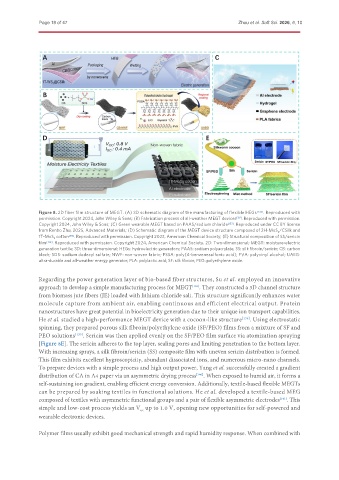
               Figure 8. 2D fiber film structure of MEGT. (A) 3D schematic diagram of the manufacturing of flexible HEGs [136] . Reproduced with
               permission. Copyright 2024, John Wiley & Sons; (B) Fabrication process of all-weather MEGT devices [39] . Reproduced with permission.
               Copyright 2024, John Wiley & Sons; (C) Green wearable MEGT based on PAAS/sodium chloride [137] . Reproduced under CC BY license
               from Renbo Zhu, 2025, Advanced Materials; (D) Schematic diagram of the MEGT device structure composed of 2H-MoS 2 /CSilk and
               1T-MoS 2  cotton [98] . Reproduced with permission. Copyright 2023, American Chemical Society; (E) Structural composition of SS/sericin
               film  [139] . Reproduced with permission. Copyright 2024, American Chemical Society. 2D: Two-dimensional; MEGT: moisture-electric
               generation textile; 3D: three-dimensional; HEGs: hydroelectric generators; PAAS: sodium polyacrylate; SS: silk fibroin/sericin; CB: carbon
               black; SDS: sodium dodecyl sulfate; NWF: non-woven fabric; PSSA: poly(4-benzenesulfonic acid); PVA: polyvinyl alcohol; UAEG:
               ultra-durable and all-weather energy generator; PLA: polylactic acid; SF: silk fibroin; PEO: polyethylene oxide.


               Regarding the power generation layer of bio-based fiber structures, Su et al. employed an innovative
               approach to develop a simple manufacturing process for MEGT . They constructed a 3D channel structure
                                                                     [138]
               from biomass jute fibers (JE) loaded with lithium chloride salt. This structure significantly enhances water
               molecule capture from ambient air, enabling continuous and efficient electrical output. Protein
               nanostructures have great potential in bioelectricity generation due to their unique ion transport capabilities.
               He et al. studied a high-performance MEGT device with a cocoon-like structure [139] . Using electrostatic
               spinning, they prepared porous silk fibroin/polyethylene oxide (SF/PEO) films from a mixture of SF and
               PEO solutions [139] . Sericin was then applied evenly on the SF/PEO film surface via atomization spraying
               [Figure 8E]. The sericin adheres to the top layer, sealing pores and limiting penetration to the bottom layer.
               With increasing sprays, a silk fibroin/sericin (SS) composite film with uneven sericin distribution is formed.
               This film exhibits excellent hygroscopicity, abundant dissociated ions, and numerous micro-nano channels.
               To prepare devices with a simple process and high output power, Yang et al. successfully created a gradient
               distribution of CA in A4 paper via an asymmetric drying process . When exposed to humid air, it forms a
                                                                      [140]
               self-sustaining ion gradient, enabling efficient energy conversion. Additionally, textile-based flexible MEGTs
               can be prepared by soaking textiles in functional solutions. He et al. developed a textile-based MEG
               composed of textiles with asymmetric functional groups and a pair of flexible asymmetric electrodes . This
                                                                                                   [141]
               simple and low-cost process yields an V  up to 1.0 V, opening new opportunities for self-powered and
                                                  oc
               wearable electronic devices.


               Polymer films usually exhibit good mechanical strength and rapid humidity response. When combined with

