


Page 59 - Read Online
P. 59
Villeda-Hernandez et al. Soft Sci 2024;4:14  https://dx.doi.org/10.20517/ss.2023.52  Page 15 of 35

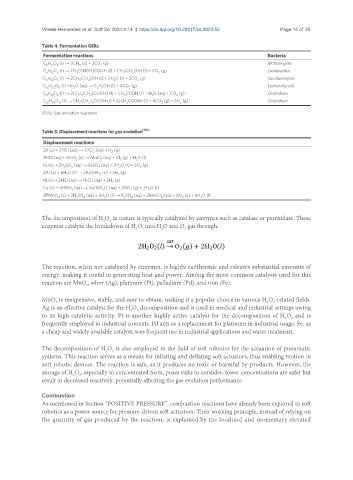
               Table 4. Fermentation GERs
                Fermentation reactions                                                     Bacteria
                C H O  (l) → 3CH  (g) + 3CO  (g)                                           Methanogens
                 6
                    6
                  12
                                   2
                            4
                C H O  (l) → CH (CHOH)COOH (l) + CH (CH )OH (l) + CO  (g)                  Lactobacillus
                 6
                                          3
                                              2
                                                      2
                  12
                    6
                           3
                C H O  (l) → 2CH (CH )OH (l) + 2H O (l) + 2CO  (g)                         Saccharomyces
                 6  12  6   3  2       2       2
                C H O  (l) + H O (aq) → C H OH (l) + 4CO  (g)                              Escherichia coli
                     11
                                            2
                                   5
                 12
                          2
                                  2
                  22
                C H O  (l) → 2[CH (CH )COOH] (l) + CH COOH (l) + H O (aq) + CO  (g)        Clostridium
                 9  18  9   3  2           3        2       2
                C H O  (l) → CH (CH ) COOH (l) + 2(CH COOH) (l) + 4CO  (g) + 6H  (g)       Clostridium
                 12  24  12  3  2 2         3          2      2
               GERs: Gas evolution reactions.
               Table 5. Displacement reactions for gas evolution [103]
                Displacement reactions
                Zn (s) + 2HCl (aq) → ZnCl  (aq) + H  (g)
                                2
                                       2
                2HCl (aq) + MnO  (s) → MnCl  (aq) + Cl  (g) + H O (l)
                           2
                                   2
                                         2
                                               2
                Fe (s) + 2H SO  (aq) → FeSO  (aq) + 2H O (l) + SO  (g)
                       2  4       4      2      2
                2Al (s) + 6H O (l) → 2Al(OH)  (s) + 3H  (g)
                                   3
                                         2
                       2
                Ni (s) + 2HCl (aq) → NiCl  (aq) + 2H  (g)
                                2
                                       2
                Cu (s) + 4HNO  (aq) → Cu(NO )2 (aq) + 2NO  (g) + 2H O (l)
                         3         3         2     2
                2KMnO  (s) + 3H SO  (aq) + 5H O (l) → K SO  (aq) + 2MnSO  (aq) + 8O  (g) + 6H O (l)
                                                              2
                             4
                                                                     2
                                           2
                                    2
                                                       4
                                             4
                           2
                     4
               The decomposition of H O  in nature is typically catalyzed by enzymes such as catalase or peroxidase. These
                                    2
                                      2
               enzymes catalyze the breakdown of H O  into H O and O  gas through:
                                                               2
                                                       2
                                                 2
                                               2
               The reaction, when not catalyzed by enzymes, is highly exothermic and releases substantial amounts of
               energy, making it useful in generating heat and power. Among the most common catalysts used for this
               reaction are MnO , silver (Ag), platinum (Pt), palladium (Pd), and iron (Fe).
                              2
               MnO  is inexpensive, stable, and easy to obtain, making it a popular choice in various H O -related fields.
                                                                                           2
                                                                                             2
                    2
               Ag is an effective catalyst for the H O  decomposition and is used in medical and industrial settings owing
                                             2
                                               2
               to its high catalytic activity. Pt is another highly active catalyst for the decomposition of H O  and is
                                                                                                   2
                                                                                                 2
               frequently employed in industrial contexts. Pd acts as a replacement for platinum in industrial usage. Fe, as
               a cheap and widely available catalyst, sees frequent use in industrial applications and water treatment.
               The decomposition of H O  is also employed in the field of soft robotics for the actuation of pneumatic
                                       2
                                     2
               systems. This reaction serves as a means for inflating and deflating soft actuators, thus enabling motion in
               soft robotic devices. The reaction is safe, as it produces no toxic or harmful by-products. However, the
               storage of H O , especially in concentrated form, poses risks to consider; lower concentrations are safer but
                          2
                            2
               result in decreased reactivity, potentially affecting the gas evolution performance.
               Combustion
               As mentioned in Section “POSITIVE PRESSURE”, combustion reactions have already been explored in soft
               robotics as a power source for pressure-driven soft actuators. Their working principle, instead of relying on
               the quantity of gas produced by the reaction, is explained by the localized and momentary elevated

