


Page 58 - Read Online
P. 58
Page 14 of 35                  Villeda-Hernandez et al. Soft Sci 2024;4:14  https://dx.doi.org/10.20517/ss.2023.52

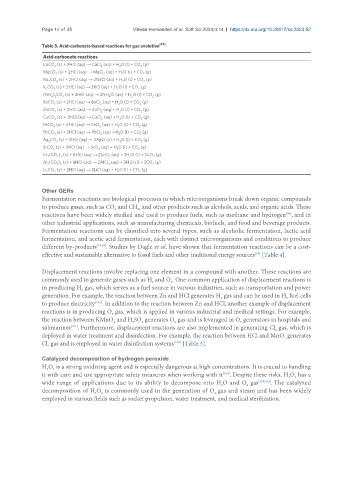
               Table 3. Acid-carbonate-based reactions for gas evolution [93]
                Acid-carbonate reactions
                CaCO  (s) + 2HCl (aq) → CaCl  (aq) + H O (l) + CO  (g)
                                   2
                   3
                                         2
                                                2
                MgCO  (s) + 2HCl (aq) → MgCl  (aq) + H O (l) + CO  (g)
                    3
                                                 2
                                    2
                                          2
                Na CO  (s) + 2HCl (aq) → 2NaCl (aq) + H O (l) + CO  (g)
                 2  3                     2      2
                K CO  (s) + 2HCl (aq) → 2KCl (aq) + H O (l) + CO  (g)
                                                2
                                        2
                2
                   3
                (NH ) CO  (s) + 2HCl (aq) → 2NH Cl (aq) + H O (l) + CO  (g)
                  4 2  3              4      2      2
                BaCO  (s) + 2HCl (aq) → BaCl  (aq) + H O (l) + CO  (g)
                   3               2     2      2
                ZnCO  (s) + 2HCl (aq) → ZnCl  (aq) + H O (l) + CO  (g)
                                         2
                                                2
                   3
                                   2
                CuCO  (s) + 2HCl (aq) → CuCl  (aq) + H O (l) + CO  (g)
                   3               2     2      2
                FeCO  (s) + 2HCl (aq) → FeCl  (aq) + H O (l) + CO  (g)
                   3               2     2      2
                PbCO  (s) + 2HCl (aq) → PbCl  (aq) + H O (l) + CO  (g)
                                                2
                                         2
                                   2
                   3
                Ag CO  (s) + 2HCl (aq) → 2AgCl (s) + H O (l) + CO  (g)
                 2  3                    2      2
                SrCO  (s) + 2HCl (aq) → SrCl  (aq) + H O (l) + CO  (g)
                   3              2     2       2
                Cr (CO )  (s) + 6HCl (aq) → 2CrCl  (aq) + 3H O (l) + 3CO  (g)
                    3 3
                                             2
                                                     2
                                      3
                 2
                Al (CO )  (s) + 6HCl (aq) → 2AlCl  (aq) + 3H O (l) + 3CO  (g)
                 2  3 3               3     2       2
                Li CO  (s) + 2HCl (aq) → 2LiCl (aq) + H O (l) + CO  (g)
                 2  3                    2      2
               Other GERs
               Fermentation reactions are biological processes in which microorganisms break down organic compounds
               to produce gases, such as CO  and CH , and other products such as alcohols, acids, and organic acids. These
                                               4
                                        2
                                                                                                 [96]
               reactions have been widely studied and used to produce fuels, such as methane and hydrogen , and in
               other industrial applications, such as manufacturing chemicals, biofuels, and food and beverage products.
               Fermentation reactions can be classified into several types, such as alcoholic fermentation, lactic acid
               fermentation, and acetic acid fermentation, each with distinct microorganisms and conditions to produce
               different by-products [97,98] . Studies by Dagle et al. have shown that fermentation reactions can be a cost-
               effective and sustainable alternative to fossil fuels and other traditional energy sources  [Table 4].
                                                                                       [99]
               Displacement reactions involve replacing one element in a compound with another. These reactions are
               commonly used to generate gases such as H  and O . One common application of displacement reactions is
                                                    2
                                                           2
               in producing H  gas, which serves as a fuel source in various industries, such as transportation and power
                            2
               generation. For example, the reaction between Zn and HCl generates H  gas and can be used in H  fuel cells
                                                                           2
                                                                                                  2
               to produce electricity . In addition to the reaction between Zn and HCl, another example of displacement
                                 [100]
               reactions is in producing O  gas, which is applied in various industrial and medical settings. For example,
                                       2
               the reaction between KMnO  and H SO  generates O  gas and is leveraged in O  generators in hospitals and
                                              2
                                                            2
                                                                                  2
                                                 4
                                       4
                         [101]
               submarines . Furthermore, displacement reactions are also implemented in generating Cl  gas, which is
                                                                                              2
               deployed in water treatment and disinfection. For example, the reaction between HCl and MnO  generates
                                                                                                 2
                                                            [102]
               Cl  gas and is employed in water disinfection systems  [Table 5].
                 2
               Catalyzed decomposition of hydrogen peroxide
               H O  is a strong oxidizing agent and is especially dangerous at high concentrations. It is crucial to handling
                   2
                 2
               it with care and use appropriate safety measures when working with it . Despite these risks, H O  has a
                                                                            [104]
                                                                                                    2
                                                                                                  2
               wide range of applications due to its ability to decompose into H O and O  gas [105,106] . The catalyzed
                                                                            2
                                                                                    2
               decomposition of H O  is commonly used in the generation of O  gas and steam and has been widely
                                 2
                                   2
                                                                         2
               employed in various fields such as rocket propulsion, water treatment, and medical sterilization.

