


Page 53 - Read Online
P. 53
Villeda-Hernandez et al. Soft Sci 2024;4:14  https://dx.doi.org/10.20517/ss.2023.52  Page 9 of 35

               Le Chatelier’s principle
               Le Chatelier’s states that when a system at equilibrium is subjected to a change, it will shift its position to
               counteract that disturbance. In the context of GERs and GCRs, this principle is of paramount importance in
               predicting how changes in pressure, volume, temperature, or concentration will affect the equilibrium
               position of the system.

               If the concentration, pressure or volume of a substance is increased, the equilibrium will shift towards the
               side that consumes that substance. Conversely, if the concentration, pressure or volume is decreased, the
               equilibrium will shift towards the side that produces that substance. Temperature changes can drastically
               affect the position of equilibrium, especially in endothermic and exothermic reactions. For endothermic
               reactions, an increase in temperature will shift the equilibrium towards the products, favoring the forward
               reaction. Conversely, decreasing the temperature will shift the equilibrium towards the reactants, favoring
               the reverse reaction.


               For reactions involving the evolution or consumption of gases, changes in volume or pressure can lead to
               profound shifts in equilibrium:


               GER: reactions that produce gas will increase the total number of gaseous moles. An increase in pressure or
               decrease in volume will shift the equilibrium to the side with fewer gas molecules, often favoring the
               reactants.


               GCR: reactions that consume gases will decrease the total number of gaseous moles. An increase in pressure
               or decrease in volume can shift the equilibrium to the side consuming the gas, often favoring the products.


               While Le Chatelier’s principle provides insight into the thermodynamic aspects of a reaction with
               temperature changes, it is essential to remember that temperature also affects reaction rates (kinetics). A
               reaction may be thermodynamically favored at a particular temperature but kinetically inactive. For a
               simple yet elegant example, see the work on phase changes in alcohols to achieve actuation by Lee et al. .
                                                                                                     [75]

               Reaction kinetics
               Reaction kinetics is the study of the rates of chemical reactions and the factors that influence these rates.
               The rate of a reaction describes how quickly the concentration of reactants decreases or the concentration of
               products increases over time .
                                       [76]

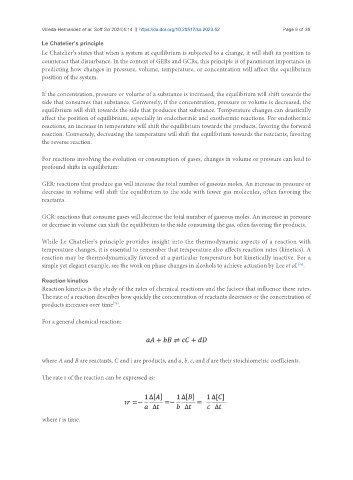
               For a general chemical reaction:


               where A and B are reactants, C and i are products, and a, b, c, and d are their stoichiometric coefficients.


               The rate r of the reaction can be expressed as:


               where t is time.

