


Page 50 - Read Online
P. 50
Page 6 of 35                   Villeda-Hernandez et al. Soft Sci 2024;4:14  https://dx.doi.org/10.20517/ss.2023.52


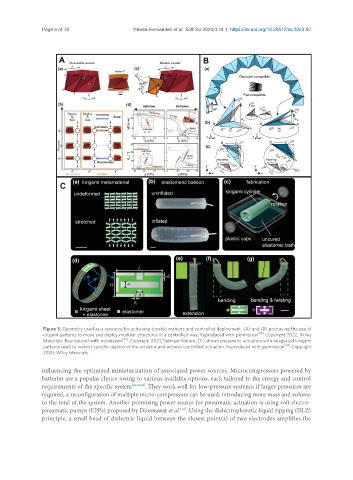
                Figure 3. Geometry used as a resource for achieving tunable motions and controlled deployment. (A) and (B) portraying the use of
                origami patterns to move and deploy modular structures in a controlled way. Reproduced with  permission [56] . Copyright 2022, Wiley
                Materials. Reproduced with  permission [55] . Copyright 2021, Springer Nature; (C) shows pneumatic actuators with integrated kirigami
                patterns used to restrict specific regions of the actuator and achieve controlled actuation. Reproduced with  permission [54] . Copyright
                2020, Wiley Materials.

               influencing the optimized miniaturization of associated power sources. Microcompressors powered by
               batteries are a popular choice owing to various available options, each tailored to the energy and control
               requirements of the specific system [60,67,68] . They work well for low-pressure systems; if larger pressures are
               required, a reconfiguration of multiple micro-compressors can be used, introducing more mass and volume
               to the total of the system. Another promising power source for pneumatic actuation is using soft electro-
               pneumatic pumps (EPPs) proposed by Diteesawat et al. . Using the dielectrophoretic liquid zipping (DLZ)
                                                              [69]
               principle, a small bead of dielectric liquid between the closest point(s) of two electrodes amplifies the

