


Page 47 - Read Online
P. 47
Villeda-Hernandez et al. Soft Sci 2024;4:14  https://dx.doi.org/10.20517/ss.2023.52  Page 3 of 35


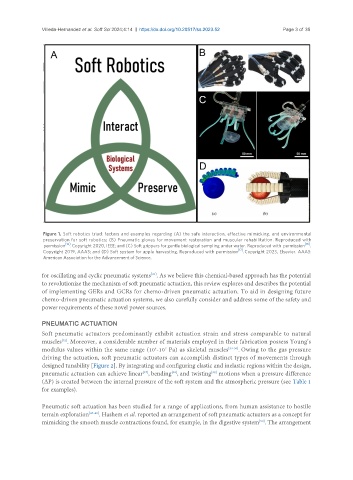
                Figure 1. Soft robotics triad: factors and examples regarding (A) the safe interaction, effective mimicking, and environmental
                preservation for soft robotics; (B) Pneumatic gloves for movement restoration and muscular rehabilitation. Reproduced with
                permission [12] . Copyright 2020, IEEE; and (C) Soft grippers for gentle biological sampling under water. Reproduced with permission [16] .
                Copyright 2019, AAAS; and (D) Soft system for apple harvesting. Reproduced with  permission [17] . Copyright 2023, Elsevier. AAAS:
                American Association for the Advancement of Science.

               for oscillating and cyclic pneumatic systems . As we believe this chemical-based approach has the potential
                                                    [31]
               to revolutionize the mechanism of soft pneumatic actuation, this review explores and describes the potential
               of implementing GERs and GCRs for chemo-driven pneumatic actuation. To aid in designing future
               chemo-driven pneumatic actuation systems, we also carefully consider and address some of the safety and
               power requirements of these novel power sources.


               PNEUMATIC ACTUATION
               Soft pneumatic actuators predominantly exhibit actuation strain and stress comparable to natural
               muscles . Moreover, a considerable number of materials employed in their fabrication possess Young’s
                      [32]
                                                         7
               modulus values within the same range (10 -10  Pa) as skeletal muscles [33-36] . Owing to the gas pressure
                                                     5
               driving the actuation, soft pneumatic actuators can accomplish distinct types of movements through
               designed tunability [Figure 2]. By integrating and configuring elastic and inelastic regions within the design,
               pneumatic actuation can achieve linear , bending , and twisting  motions when a pressure difference
                                                 [37]
                                                           [38]
                                                                        [39]
               (∆P) is created between the internal pressure of the soft system and the atmospheric pressure (see Table 1
               for examples).
               Pneumatic soft actuation has been studied for a range of applications, from human assistance to hostile
               terrain exploration [47-49] . Hashem et al. reported an arrangement of soft pneumatic actuators as a concept for
               mimicking the smooth muscle contractions found, for example, in the digestive system . The arrangement
                                                                                        [50]

