


Page 49 - Read Online
P. 49
Villeda-Hernandez et al. Soft Sci 2024;4:14  https://dx.doi.org/10.20517/ss.2023.52  Page 5 of 35


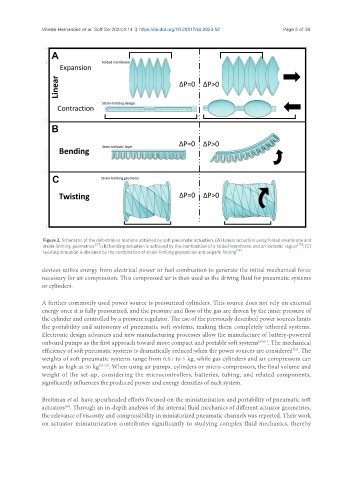
                Figure 2. Schematic of the deformation motions obtained by soft pneumatic actuation. (A) Linear actuation using folded membrane and
                strain-limiting geometries [37] ; (B) bending actuation is achieved by the combination of a folded membrane and an inelastic region [38] ; (C)
                twisting actuation is obtained by the combination of strain-limiting geometries and origami folding [39] .

               devices utilize energy from electrical power or fuel combustion to generate the initial mechanical force
               necessary for air compression. This compressed air is then used as the driving fluid for pneumatic systems
               or cylinders.


               A further commonly used power source is pressurized cylinders. This source does not rely on external
               energy once it is fully pressurized, and the pressure and flow of the gas are driven by the inner pressure of
               the cylinder and controlled by a pressure regulator. The use of the previously described power sources limits
               the portability and autonomy of pneumatic soft systems, making them completely tethered systems.
               Electronic design advances and new manufacturing processes allow the manufacture of battery-powered
               onboard pumps as the first approach toward more compact and portable soft systems [60,61] . The mechanical
               efficiency of soft pneumatic systems is dramatically reduced when the power sources are considered . The
                                                                                                    [62]
               weights of soft pneumatic systems range from 0.01 to 1 kg, while gas cylinders and air compressors can
               weigh as high as 50 kg [63-65] . When using air pumps, cylinders or micro-compressors, the final volume and
               weight of the set-up, considering the microcontrollers, batteries, tubing, and related components,
               significantly influences the produced power and energy densities of each system.

               Breitman et al. have spearheaded efforts focused on the miniaturization and portability of pneumatic soft
               actuators . Through an in-depth analysis of the internal fluid mechanics of different actuator geometries,
                       [66]
               the relevance of viscosity and compressibility in miniaturized pneumatic channels was reported. Their work
               on actuator miniaturization contributes significantly to studying complex fluid mechanics, thereby

