


Page 54 - Read Online
P. 54
Page 10 of 35                  Villeda-Hernandez et al. Soft Sci 2024;4:14  https://dx.doi.org/10.20517/ss.2023.52

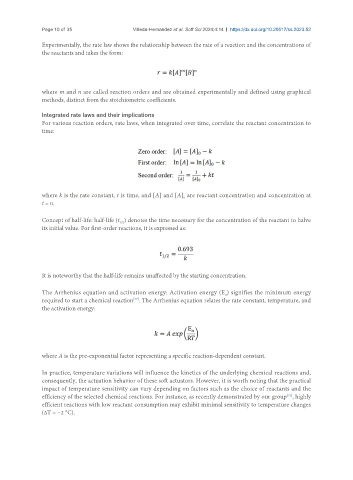
               Experimentally, the rate law shows the relationship between the rate of a reaction and the concentrations of
               the reactants and takes the form:


               where m and n are called reaction orders and are obtained experimentally and defined using graphical
               methods, distinct from the stoichiometric coefficients.


               Integrated rate laws and their implications
               For various reaction orders, rate laws, when integrated over time, correlate the reactant concentration to
               time:


               where k is the rate constant, t is time, and [A] and [A]  are reactant concentration and concentration at
                                                               0
               t = 0.


               Concept of half-life: half-life (t ) denotes the time necessary for the concentration of the reactant to halve
                                         1/2
               its initial value. For first-order reactions, it is expressed as:


               It is noteworthy that the half-life remains unaffected by the starting concentration.


               The Arrhenius equation and activation energy: Activation energy (E ) signifies the minimum energy
                                                                             a
               required to start a chemical reaction . The Arrhenius equation relates the rate constant, temperature, and
                                              [77]
               the activation energy:


               where A is the pre-exponential factor representing a specific reaction-dependent constant.


               In practice, temperature variations will influence the kinetics of the underlying chemical reactions and,
               consequently, the actuation behavior of these soft actuators. However, it is worth noting that the practical
               impact of temperature sensitivity can vary depending on factors such as the choice of reactants and the
                                                                                                  [31]
               efficiency of the selected chemical reactions. For instance, as recently demonstrated by our group , highly
               efficient reactions with low reactant consumption may exhibit minimal sensitivity to temperature changes
               (ΔT = ~2 °C).

