


Page 56 - Read Online
P. 56
Page 12 of 35                  Villeda-Hernandez et al. Soft Sci 2024;4:14  https://dx.doi.org/10.20517/ss.2023.52


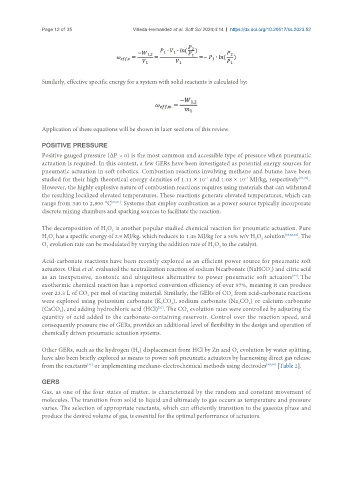
               Similarly, effective specific energy for a system with solid reactants is calculated by:


               Application of these equations will be shown in later sections of this review.


               POSITIVE PRESSURE
               Positive gauged pressure (∆P > 0) is the most common and accessible type of pressure when pneumatic
               actuation is required. In this context, a few GERs have been investigated as potential energy sources for
               pneumatic actuation in soft robotics. Combustion reactions involving methane and butane have been
               studied for their high theoretical energy densities of 1.11 × 10  and 1.08 × 10  MJ/kg, respectively [78,79] .
                                                                                    -2
                                                                      -2
               However, the highly explosive nature of combustion reactions requires using materials that can withstand
               the resulting localized elevated temperatures. These reactions generate elevated temperatures, which can
               range from 340 to 2,800 °C [80,81] . Systems that employ combustion as a power source typically incorporate
               discrete mixing chambers and sparking sources to facilitate the reaction.

               The decomposition of H O  is another popular studied chemical reaction for pneumatic actuation. Pure
                                       2
                                     2
               H O  has a specific energy of 2.9 MJ/kg, which reduces to 1.45 MJ/kg for a 50% w/v H O  solution [78,82,83] . The
                   2
                                                                                         2
                                                                                       2
                 2
               O  evolution rate can be modulated by varying the addition rate of H O  to the catalyst.
                                                                           2
                 2
                                                                         2
               Acid-carbonate reactions have been recently explored as an efficient power source for pneumatic soft
               actuators. Okui et al. evaluated the neutralization reaction of sodium bicarbonate (NaHCO ) and citric acid
                                                                                            3
               as an inexpensive, nontoxic and ubiquitous alternative to power pneumatic soft actuators . The
                                                                                                    [84]
               exothermic chemical reaction has a reported conversion efficiency of over 97%, meaning it can produce
               over 23.3 L of CO  per mol of starting material. Similarly, the GERs of CO  from acid-carbonate reactions
                                                                               2
                              2
               were explored using potassium carbonate (K CO ), sodium carbonate (Na CO ) or calcium carbonate
                                                       2
                                                           3
                                                                                     3
                                                                                 2
                                                      [31]
               (CaCO ), and adding hydrochloric acid (HCl) . The CO  evolution rates were controlled by adjusting the
                                                                2
                     3
               quantity of acid added to the carbonate-containing reservoir. Control over the reaction speed, and
               consequently pressure rise of GERs, provides an additional level of flexibility in the design and operation of
               chemically driven pneumatic actuation systems.
               Other GERs, such as the hydrogen (H ) displacement from HCl by Zn and O  evolution by water splitting,
                                               2
                                                                                 2
               have also been briefly explored as means to power soft pneumatic actuators by harnessing direct gas release
               from the reactants  or implementing mechano-electrochemical methods using electrodes [85,86]  [Table 2].
                              [31]
               GERS
               Gas, as one of the four states of matter, is characterized by the random and constant movement of
               molecules. The transition from solid to liquid and ultimately to gas occurs as temperature and pressure
               varies. The selection of appropriate reactants, which can efficiently transition to the gaseous phase and
               produce the desired volume of gas, is essential for the optimal performance of actuators.

