


Page 55 - Read Online
P. 55
Villeda-Hernandez et al. Soft Sci 2024;4:14  https://dx.doi.org/10.20517/ss.2023.52  Page 11 of 35

               Energetic considerations
               As described by Adami et al. for GERs and GCRs, the energy storage can be described in terms of fuel, even
               if not a conventional combustible fuel . To accurately describe a pressure generation method, it is essential
                                               [78]
               to consider the quantity of gas that can be generated.

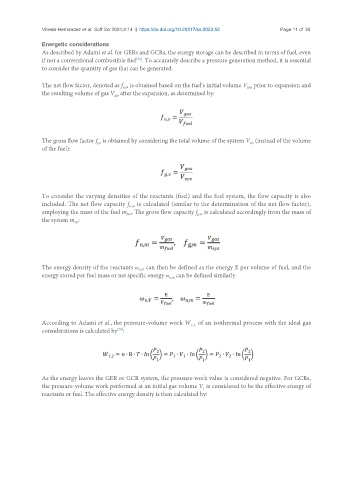
               The net flow factor, denoted as f , is obtained based on the fuel’s initial volume V  prior to expansion and
                                          n,v
                                                                                    fuel
               the resulting volume of gas V  after the expansion, as determined by:
                                        gas


               The gross flow factor f  is obtained by considering the total volume of the system V  (instead of the volume
                                                                                     sys
                                  g,v
               of the fuel):


               To consider the varying densities of the reactants (fuel) and the fuel system, the flow capacity is also
               included. The net flow capacity f  is calculated (similar to the determination of the net flow factor),
                                             n,m
               employing the mass of the fuel m . The gross flow capacity f  is calculated accordingly from the mass of
                                                                    g,m
                                            fuel
               the system m :
                          sys


               The energy density of the reactants ω  can then be defined as the energy E per volume of fuel, and the
                                                n,V
               energy stored per fuel mass or net specific energy ω  can be defined similarly.
                                                          n,m


               According to Adami et al., the pressure-volume work W  of an isothermal process with the ideal gas
                                                                 1,2,
               considerations is calculated by :
                                         [78]


               As the energy leaves the GER or GCR system, the pressure-work value is considered negative. For GCRs,
               the pressure-volume work performed at an initial gas volume V  is considered to be the effective energy of
                                                                     1
               reactants or fuel. The effective energy density is then calculated by:

