


Page 61 - Read Online
P. 61
Villeda-Hernandez et al. Soft Sci 2024;4:14  https://dx.doi.org/10.20517/ss.2023.52  Page 17 of 35

               Table 6. Combustion gas evolution [103]
                Combustion reactions
                Combustion of methane
                CH  (g) + 2O  (g) → CO  (g) + 2H O
                  4     2      2     2
                Combustion of ethane
                2C H  (g) + 7O  (g) → 4CO  (g) + 6H O
                                       2
                   6
                         2
                 2
                                 2
                Combustion of butane
                2C H  (g) +13O  (g) → 8CO  (g) + 10H O
                                         2
                          2
                 4
                                  2
                   10
                Combustion of propane
                C H  (g) + 5O  (g) → 3CO  (g) + 4H O
                        2
                                2
                 3
                                       2
                  8
               Table 7. Thermal decomposition reactions for gas evolution [108]
                Thermal decomposition reactions
                Decomposition of sodium bicarbonate
                2NaHCO  (s) → Na CO  (s) + H O (g) + CO  (g)
                     3      2  3    2      2
                Decomposition of sodium azide
                2NaN  (s) → 2Na (s) + 3N  (g)
                   3            2
                Decomposition of mercury oxide
                2HgO (s) → 2Hg (l) + O  (g)
                               2


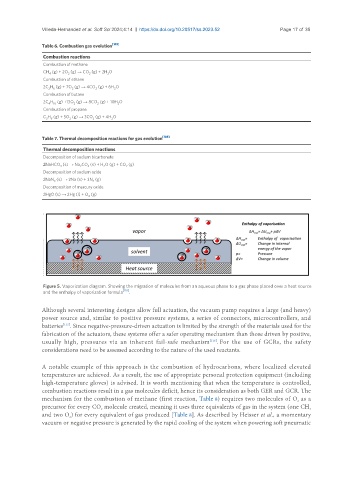
                Figure 5. Vaporization diagram. Showing the migration of molecules from an aqueous phase to a gas phase placed over a heat source
                                          [110]
                and the enthalpy of vaporization formula  .
               Although several interesting designs allow full actuation, the vacuum pump requires a large (and heavy)
               power source and, similar to positive pressure systems, a series of connectors, microcontrollers, and
                      [115]
               batteries . Since negative-pressure-driven actuation is limited by the strength of the materials used for the
               fabrication of the actuators, these systems offer a safer operating mechanism than those driven by positive,
                                                                        [116]
               usually  high,  pressures  via  an  inherent  fail-safe  mechanism . For  the  use  of  GCRs,  the  safety
               considerations need to be assessed according to the nature of the used reactants.

               A notable example of this approach is the combustion of hydrocarbons, where localized elevated
               temperatures are achieved. As a result, the use of appropriate personal protection equipment (including
               high-temperature gloves) is advised. It is worth mentioning that when the temperature is controlled,
               combustion reactions result in a gas molecules deficit, hence its consideration as both GER and GCR. The
               mechanism for the combustion of methane (first reaction, Table 8) requires two molecules of O  as a
                                                                                                     2
               precursor for every CO  molecule created, meaning it uses three equivalents of gas in the system (one CH
                                                                                                         4
                                   2
               and two O ) for every equivalent of gas produced [Table 8]. As described by Heisser et al., a momentary
                        2
               vacuum or negative pressure is generated by the rapid cooling of the system when powering soft pneumatic

