


Page 63 - Read Online
P. 63
Villeda-Hernandez et al. Soft Sci 2024;4:14  https://dx.doi.org/10.20517/ss.2023.52  Page 19 of 35

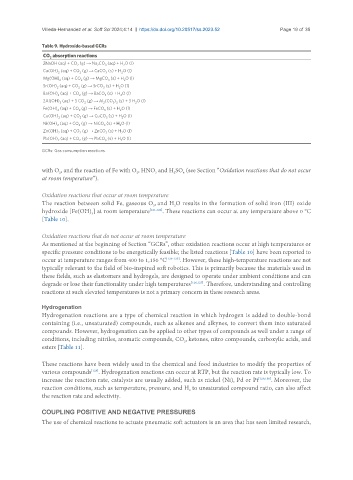
               Table 9. Hydroxide-based GCRs
                CO  absorption reactions
                  2
                2NaOH (aq) + CO  (g) → Na CO  (aq) + H O (l)
                           2
                                  2
                                    3
                                           2
                Ca(OH)  (aq) + CO  (g) → CaCO  (s) + H O (l)
                                          2
                     2
                                     3
                            2
                Mg(OH)  (aq) + CO  (g) → MgCO  (s) + H O (l)
                     2      2        3     2
                Sr(OH)  (aq) + CO  (g) → SrCO  (s) + H O (l)
                    2
                           2
                                         2
                                    3
                Ba(OH)  (aq) + CO  (g) → BaCO  (s) + H O (l)
                    2       2       3     2
                2Al(OH)  (aq) + 3 CO  (g) → Al (CO )  (s) + 3 H O (l)
                     3       2      2  3 3     2
                Fe(OH)  (aq) + CO  (g) → FeCO  (s) + H O (l)
                    2
                                         2
                                    3
                            2
                Cu(OH)  (aq) + CO  (g) → CuCO  (s) + H O (l)
                     2      2        3    2
                Ni(OH)  (aq) + CO  (g) → NiCO  (s) + H O (l)
                    2       2       3    2
                Zn(OH)  (aq) + CO  (g) → ZnCO  (s) + H O (l)
                                          2
                            2
                     2
                                     3
                Pb(OH)  (aq) + CO  (g) → PbCO  (s) + H O (l)
                     2      2       3     2
               GCRs: Gas consumption reactions.
               with O , and the reaction of Fe with O , HNO  and H SO  (see Section “Oxidation reactions that do not occur
                                                               4
                                                     3
                                               2
                     2
                                                            2
               at room temperature”).
               Oxidation reactions that occur at room temperature
               The reaction between solid Fe, gaseous O , and H O results in the formation of solid iron (III) oxide
                                                     2
                                                            2
               hydroxide [Fe(OH) ] at room temperature [121,122] . These reactions can occur at any temperature above 0 °C
                                3
               [Table 10].
               Oxidation reactions that do not occur at room temperature
               As mentioned at the beginning of Section “GCRs”, other oxidation reactions occur at high temperatures or
               specific pressure conditions to be energetically feasible; the listed reactions [Table 10] have been reported to
               occur at temperature ranges from 400 to 1,150 °C [123-125] . However, these high-temperature reactions are not
               typically relevant to the field of bio-inspired soft robotics. This is primarily because the materials used in
               these fields, such as elastomers and hydrogels, are designed to operate under ambient conditions and can
               degrade or lose their functionality under high temperatures [126,127] . Therefore, understanding and controlling
               reactions at such elevated temperatures is not a primary concern in these research areas.
               Hydrogenation
               Hydrogenation reactions are a type of chemical reaction in which hydrogen is added to double-bond
               containing (i.e., unsaturated) compounds, such as alkenes and alkynes, to convert them into saturated
               compounds. However, hydrogenation can be applied to other types of compounds as well under a range of
               conditions, including nitriles, aromatic compounds, CO , ketones, nitro compounds, carboxylic acids, and
                                                               2
               esters [Table 11].
               These reactions have been widely used in the chemical and food industries to modify the properties of
                                [128]
               various compounds . Hydrogenation reactions can occur at RTP, but the reaction rate is typically low. To
               increase the reaction rate, catalysts are usually added, such as nickel (Ni), Pd or Pt [129,130] . Moreover, the
               reaction conditions, such as temperature, pressure, and H  to unsaturated compound ratio, can also affect
                                                                 2
               the reaction rate and selectivity.
               COUPLING POSITIVE AND NEGATIVE PRESSURES
               The use of chemical reactions to actuate pneumatic soft actuators is an area that has seen limited research,

