


Page 66 - Read Online
P. 66
Page 22 of 35                  Villeda-Hernandez et al. Soft Sci 2024;4:14  https://dx.doi.org/10.20517/ss.2023.52


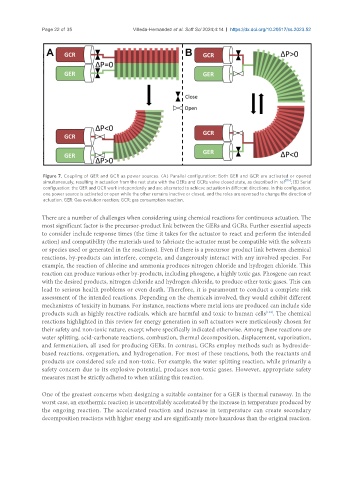
                Figure 7. Coupling of GER and GCR as power sources. (A) Parallel configuration: Both GER and GCR are activated or opened
                simultaneously, resulting in actuation from the rest state with the GERs and GCRs valve closed state, as described in  ref [115] ; (B) Serial
                configuration: the GER and GCR work independently and are alternated to achieve actuation in different directions. In this configuration,
                one power source is activated or open while the other remains inactive or closed, and the roles are reversed to change the direction of
                actuation. GER: Gas evolution reaction; GCR: gas consumption reaction.

               There are a number of challenges when considering using chemical reactions for continuous actuation. The
               most significant factor is the precursor-product link between the GERs and GCRs. Further essential aspects
               to consider include response times (the time it takes for the actuator to react and perform the intended
               action) and compatibility (the materials used to fabricate the actuator must be compatible with the solvents
               or species used or generated in the reactions). Even if there is a precursor–product link between chemical
               reactions, by-products can interfere, compete, and dangerously interact with any involved species. For
               example, the reaction of chlorine and ammonia produces nitrogen chloride and hydrogen chloride. This
               reaction can produce various other by-products, including phosgene, a highly toxic gas. Phosgene can react
               with the desired products, nitrogen chloride and hydrogen chloride, to produce other toxic gases. This can
               lead to serious health problems or even death. Therefore, it is paramount to conduct a complete risk
               assessment of the intended reactions. Depending on the chemicals involved, they would exhibit different
               mechanisms of toxicity in humans. For instance, reactions where metal ions are produced can include side
               products such as highly reactive radicals, which are harmful and toxic to human cells . The chemical
                                                                                           [133]
               reactions highlighted in this review for energy generation in soft actuators were meticulously chosen for
               their safety and non-toxic nature, except where specifically indicated otherwise. Among these reactions are
               water splitting, acid-carbonate reactions, combustion, thermal decomposition, displacement, vaporization,
               and fermentation, all used for producing GERs. In contrast, GCRs employ methods such as hydroxide-
               based reactions, oxygenation, and hydrogenation. For most of these reactions, both the reactants and
               products are considered safe and non-toxic. For example, the water splitting reaction, while primarily a
               safety concern due to its explosive potential, produces non-toxic gases. However, appropriate safety
               measures must be strictly adhered to when utilizing this reaction.

               One of the greatest concerns when designing a suitable container for a GER is thermal runaway. In the
               worst case, an exothermic reaction is uncontrollably accelerated by the increase in temperature produced by
               the ongoing reaction. The accelerated reaction and increase in temperature can create secondary
               decomposition reactions with higher energy and are significantly more hazardous than the original reaction.

