


Page 71 - Read Online
P. 71
Villeda-Hernandez et al. Soft Sci 2024;4:14  https://dx.doi.org/10.20517/ss.2023.52  Page 27 of 35


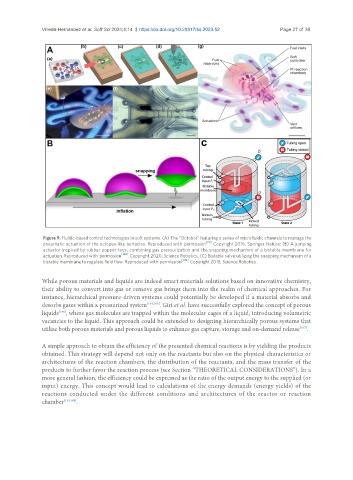
                Figure 9. Fluidic-based control technologies in soft systems. (A) The “Octobot” featuring a series of microfluidic channels to manage the
                pneumatic actuation of the octopus-like tentacles. Reproduced with  permission [70] . Copyright 2016, Springer Nature; (B) A jumping
                actuator inspired by rubber popper toys, combining gas pressurization and the snapping mechanism of a bistable membrane for
                actuation. Reproduced with permission [148] . Copyright 2020, Science Robotics; (C) Bistable valve utilizing the snapping mechanism of a
                bistable membrane to regulate fluid flow. Reproduced with permission [149] . Copyright 2018, Science Robotics.

               While porous materials and liquids are indeed smart materials solutions based on innovative chemistry,
               their ability to convert into gas or remove gas brings them into the realm of chemical approaches. For
               instance, hierarchical pressure-driven systems could potentially be developed if a material absorbs and
               desorbs gases within a pressurized system [164,165] . Giri et al. have successfully explored the concept of porous
               liquids , where gas molecules are trapped within the molecular cages of a liquid, introducing volumetric
                     [166]
               vacancies to the liquid. This approach could be extended to designing hierarchically porous systems that
               utilize both porous materials and porous liquids to enhance gas capture, storage and on-demand release .
                                                                                                      [167]

               A simple approach to obtain the efficiency of the presented chemical reactions is by yielding the products
               obtained. This strategy will depend not only on the reactants but also on the physical characteristics or
               architectures of the reaction chambers, the distribution of the reactants, and the mass transfer of the
               products to further favor the reaction process (see Section “THEORETICAL CONSIDERATIONS”). In a
               more general fashion, the efficiency could be expressed as the ratio of the output energy to the supplied (or
               input) energy. This concept would lead to calculations of the energy demands (energy yields) of the
               reactions conducted under the different conditions and architectures of the reactor or reaction
               chamber [134,168] .

