


Page 64 - Read Online
P. 64
Page 20 of 35                  Villeda-Hernandez et al. Soft Sci 2024;4:14  https://dx.doi.org/10.20517/ss.2023.52

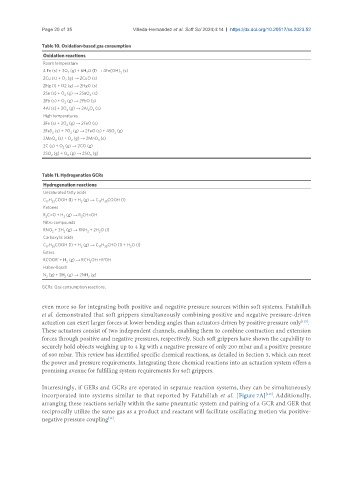
               Table 10. Oxidation-based gas consumption
                Oxidation reactions
                Room temperature
                4 Fe (s) + 3O  (g) + 6H O (l) → 4Fe(OH)  (s)
                        2     2           3
                2Cu (s) + O  (g) → 2CuO (s)
                       2
                2Hg (l) + O2 (g) → 2HgO (s)
                2Sn (s) + O  (g) → 2SnO  (s)
                       2       2
                2Pb (s) + O  (g) → 2PbO (s)
                       2
                4Al (s) + 3O  (g) → 2Al O  (s)
                               2
                                3
                       2
                High temperatures
                2Fe (s) + 3O  (g) → 2FeO (s)
                       2
                2FeS  (s) + 7O  (g) → 2FeO (s) + 4SO  (g)
                   2
                                        2
                         2
                2MnO  (s) + O  (g) → 2MnO  (s)
                    2    2        3
                2C (s) + O  (g) → 2CO (g)
                      2
                2SO  (g) + O  (g) → 2SO  (g)
                  2
                        2
                               3
               Table 11. Hydrogenation GCRs
                Hydrogenation reactions
                Unsaturated fatty acids
                C H COOH (l) + H  (g) → C H COOH (l)
                                  17
                                    35
                            2
                 17
                  33
                Ketones
                R C−O + H  (g) → R CH−OH
                2
                            2
                      2
                Nitro compounds
                RNO  + 3H  (g) → RNH  + 2H O (l)
                   2  2       2   2
                Carboxylic acids
                C H COOH (l) + H  (g) → C H CHO (l) + H O (l)
                 17  35     2     17  35     2
                Esters
                RCOOR’ + H  (g) → RCH OH +R′OH
                               2
                       2
                Haber-Bosch
                N  (g) + 3H  (g) → 2NH  (g)
                               3
                 2
                       2
               GCRs: Gas consumption reactions.
               even more so for integrating both positive and negative pressure sources within soft systems. Fatahillah
               et al. demonstrated that soft grippers simultaneously combining positive and negative pressure-driven
                                                                                                      [115]
               actuation can exert larger forces at lower bending angles than actuators driven by positive pressure only .
               These actuators consist of two independent channels, enabling them to combine contraction and extension
               forces through positive and negative pressures, respectively. Such soft grippers have shown the capability to
               securely hold objects weighing up to 4 kg with a negative pressure of only 200 mbar and a positive pressure
               of 600 mbar. This review has identified specific chemical reactions, as detailed in Section 3, which can meet
               the power and pressure requirements. Integrating these chemical reactions into an actuation system offers a
               promising avenue for fulfilling system requirements for soft grippers.
               Interestingly, if GERs and GCRs are operated in separate reaction systems, they can be simultaneously
                                                                                           [115]
               incorporated into systems similar to that reported by Fatahillah et al. [Figure 7A] . Additionally,
               arranging these reactions serially within the same pneumatic system and pairing of a GCR and GER that
               reciprocally utilize the same gas as a product and reactant will facilitate oscillating motion via positive-
               negative pressure coupling .
                                      [31]

