


Page 48 - Read Online
P. 48
Page 4 of 35                   Villeda-Hernandez et al. Soft Sci 2024;4:14  https://dx.doi.org/10.20517/ss.2023.52

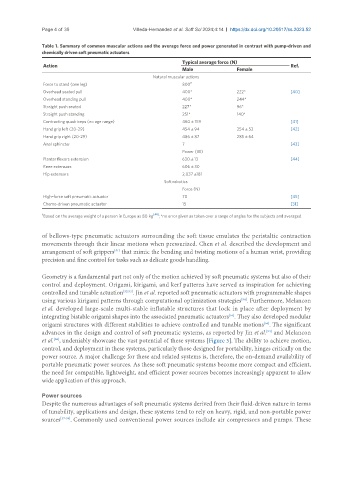
               Table 1. Summary of common muscular actions and the average force and power generated in contrast with pump-driven and
               chemically driven soft pneumatic actuators
                                                              Typical average force (N)
                Action                                                                             Ref.
                                                              Male               Female
                                                     Natural muscular actions
                                                                 a
                Force to stand (one leg)                      800
                Overhead seated pull                          400*               222*              [40]
                Overhead standing pull                        400*               244*
                Straight push seated                          227*               96*
                Straight push standing                        251*               140*
                Contracting quadriceps (no age range)         460 ± 159                            [41]
                Hand grip left (20-29)                        454 ± 94           254 ± 52          [42]
                Hand grip right (20-29)                       486 ± 87           285 ± 64
                Anal sphincter                                7                                    [43]
                                                              Power (W)
                Plantar flexors extension                     630 ± 13                             [44]
                Knee extensors                                606 ± 30
                Hip extensors                                 2,037 ±181
                                                        Soft robotics
                                                              Force (N)
                High-force soft pneumatic actuator            70                                   [45]
                Chemo-driven pneumatic actuator               15                                   [31]

               a                                     [46]
                Based on the average weight of a person in Europe as 80 kg  ; *no error given as taken over a range of angles for the subjects and averaged.

               of bellows-type pneumatic actuators surrounding the soft tissue emulates the peristaltic contraction
               movements through their linear motions when pressurized. Chen et al. described the development and
               arrangement of soft grippers  that mimic the bending and twisting motions of a human wrist, providing
                                        [51]
               precision and fine control for tasks such as delicate goods handling.

               Geometry is a fundamental part not only of the motion achieved by soft pneumatic systems but also of their
               control and deployment. Origami, kirigami, and kerf patterns have served as inspiration for achieving
               controlled and tunable actuation [52,53] . Jin et al. reported soft pneumatic actuators with programmable shapes
               using various kirigami patterns through computational optimization strategies . Furthermore, Melancon
                                                                                  [54]
               et al. developed large-scale multi-stable inflatable structures that lock in place after deployment by
               integrating bistable origami shapes into the associated pneumatic actuators . They also developed modular
                                                                              [55]
                                                                                          [56]
               origami structures with different stabilities to achieve controlled and tunable motions . The significant
               advances in the design and control of soft pneumatic systems, as reported by Jin et al.  and Melancon
                                                                                           [54]
               et al. , undeniably showcase the vast potential of these systems [Figure 3]. The ability to achieve motion,
                   [56]
               control, and deployment in these systems, particularly those designed for portability, hinges critically on the
               power source. A major challenge for these and related systems is, therefore, the on-demand availability of
               portable pneumatic power sources. As these soft pneumatic systems become more compact and efficient,
               the need for compatible, lightweight, and efficient power sources becomes increasingly apparent to allow
               wide application of this approach.


               Power sources
               Despite the numerous advantages of soft pneumatic systems derived from their fluid-driven nature in terms
               of tunability, applications and design, these systems tend to rely on heavy, rigid, and non-portable power
               sources [57-59] . Commonly used conventional power sources include air compressors and pumps. These

