


Page 123 - Read Online
P. 123
Peng et al. Soft Sci. 2025, 5, 38  https://dx.doi.org/10.20517/ss.2025.31        Page 9 of 19

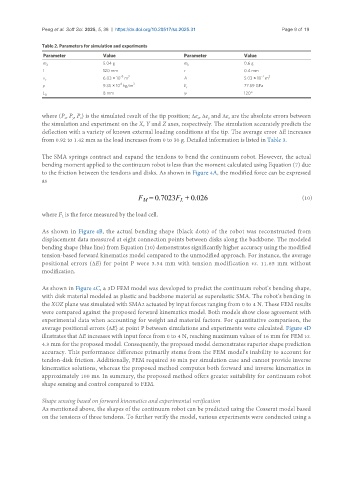
               Table 2. Parameters for simulation and experiments
                Parameter           Value                      Parameter           Value
                m d                 5.04 g                     m b                 0.6 g
                l                   120 mm                     r                   0.4 mm
                                          -8  3                                          -7  2
                v r                 6.03 × 10  m               A                   5.03 × 10  m
                                          4
                ρ                   9.35 × 10  kg/m 3          E r                 77.59 GPa
                L                   8 mm                       ψ                   120°
                0

               where (P , P , P ) is the simulated result of the tip position; Δe , Δe  and Δe  are the absolute errors between
                                                                              z
                                                                       y
                         y
                       x
                            z
                                                                    x
               the simulation and experiment on the X, Y and Z axes, respectively. The simulation accurately predicts the
               deflection with a variety of known external loading conditions at the tip. The average error ΔE increases
               from 0.92 to 1.42 mm as the load increases from 0 to 30 g. Detailed information is listed in Table 3.
               The SMA springs contract and expand the tendons to bend the continuum robot. However, the actual
               bending moment applied to the continuum robot is less than the moment calculated using Equation (7) due
               to the friction between the tendons and disks. As shown in Figure 4A, the modified force can be expressed
               as


                                                                                                       (10)

               where F  is the force measured by the load cell.
                      L

               As shown in Figure 4B, the actual bending shape (black dots) of the robot was reconstructed from
               displacement data measured at eight connection points between disks along the backbone. The modeled
               bending shape (blue line) from Equation (10) demonstrates significantly higher accuracy using the modified
               tension-based forward kinematics model compared to the unmodified approach. For instance, the average
               positional errors (ΔE) for point P were 3.34 mm with tension modification vs. 11.65 mm without
               modification.


               As shown in Figure 4C, a 3D FEM model was developed to predict the continuum robot’s bending shape,
               with disk material modeled as plastic and backbone material as superelastic SMA. The robot’s bending in
               the XOZ plane was simulated with SMA2 actuated by input forces ranging from 0 to 4 N. These FEM results
               were compared against the proposed forward kinematics model. Both models show close agreement with
               experimental data when accounting for weight and material factors. For quantitative comparison, the
               average positional errors (ΔE) at point P between simulations and experiments were calculated. Figure 4D
               illustrates that ∆E increases with input force from 0 to 4 N, reaching maximum values of 16 mm for FEM vs.
               4.3 mm for the proposed model. Consequently, the proposed model demonstrates superior shape prediction
               accuracy. This performance difference primarily stems from the FEM model’s inability to account for
               tendon-disk friction. Additionally, FEM required 30 min per simulation case and cannot provide inverse
               kinematics solutions, whereas the proposed method computes both forward and inverse kinematics in
               approximately 100 ms. In summary, the proposed method offers greater suitability for continuum robot
               shape sensing and control compared to FEM.


               Shape sensing based on forward kinematics and experimental verification
               As mentioned above, the shapes of the continuum robot can be predicted using the Cosserat model based
               on the tensions of three tendons. To further verify the model, various experiments were conducted using a

