


Page 126 - Read Online
P. 126
Page 12 of 19                          Peng et al. Soft Sci. 2025, 5, 38  https://dx.doi.org/10.20517/ss.2025.31

               Shape sensing and control
               To accurately sense and regulate the bending shape of the continuum robot, a control method based on
               Cosserat rod theory is applied to trajectory planning and tracking experiments. To increase the position
               tracking accuracy and robustness of SMA, many schemes based on hysteresis models of SMA have been
               proposed. Because SMA is very sensitive to temperature, it is difficult to obtain an accurate hysteresis
               model. Therefore, many model-free schemes, such as proportional integral derivative (PID) controllers and
               artificial neural networks, have been developed to increase the position tracking accuracy and robustness of
               SMA. Here, a closed-loop control method based on a radial basis function (RBF) is applied to compensate
               for the disturbance (hysteresis effect and unknown dynamics of the SMA actuator) and to achieve accurate
               bending shape control of a continuum robot. As shown in Figure 6, the block diagram of the control
               scheme implemented to control the robot can be divided into three parts. Part 1 corresponds to the method
               of calculating the tension in accordance with the inverse kinematics, which can be expressed as Equation (7)
               and Algorithm 2. Part 2 represents the tension control strategy based on RBF compensation. Part 3
               represents the method of shape sensing in accordance with the forward kinematics, which is given in
               Algorithm 1.


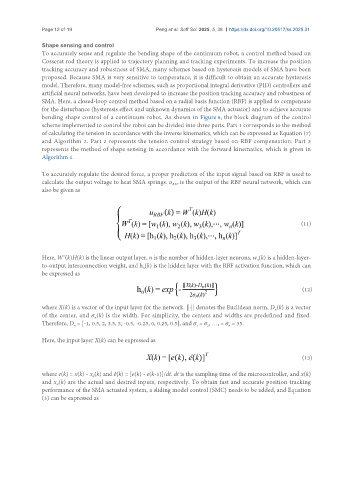
               To accurately regulate the desired force, a proper prediction of the input signal based on RBF is used to
               calculate the output voltage to heat SMA springs. u  is the output of the RBF neural network, which can
                                                           RBF
               also be given as


                                                                                                       (11)


               Here, W (k)H(k) is the linear output layer, n is the number of hidden-layer neurons, w (k) is a hidden-layer-
                      T
                                                                                        n
               to-output interconnection weight, and h (k) is the hidden layer with the RBF activation function, which can
                                                 n
               be expressed as
                                                                                                       (12)


               where X(k) is a vector of the input layer for the network. ||·|| denotes the Euclidean norm, D (k) is a vector
                                                                                              n
               of the center, and σ (k) is the width. For simplicity, the centers and widths are predefined and fixed.
                                 n
               Therefore, D  = [-1, 0.5, 2, 3.5, 5; -0.5, -0.25, 0, 0.25, 0.5], and σ  = σ , …, = σ  = 35.
                                                                       2
                                                                   1
                          n
                                                                              n
               Here, the input layer X(k) can be expressed as
                                                                                                       (13)


               where e(k) = x(k) - x (k) and e(k) = [e(k) - e(k-1)]/dt. dt is the sampling time of the microcontroller, and x(k)
                                d
               and x (k) are the actual and desired inputs, respectively. To obtain fast and accurate position tracking
                    d
               performance of the SMA actuated system, a sliding model control (SMC) needs to be added, and Equation
               (3) can be expressed as

