


Page 125 - Read Online
P. 125
Peng et al. Soft Sci. 2025, 5, 38  https://dx.doi.org/10.20517/ss.2025.31       Page 11 of 19


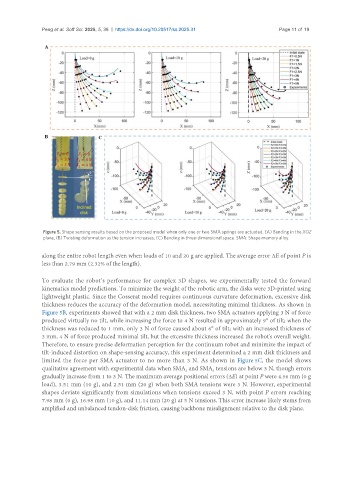
                Figure 5. Shape sensing results based on the proposed model when only one or two SMA springs are actuated. (A) Bending in the XOZ
                plane; (B) Twisting deformation as the tension increases; (C) Bending in three-dimensional space. SMA: Shape memory alloy.

               along the entire robot length even when loads of 10 and 20 g are applied. The average error ΔE of point P is
               less than 2.79 mm (2.32% of the length).

               To evaluate the robot’s performance for complex 3D shapes, we experimentally tested the forward
               kinematics model predictions. To minimize the weight of the robotic arm, the disks were 3D-printed using
               lightweight plastic. Since the Cosserat model requires continuous curvature deformation, excessive disk
               thickness reduces the accuracy of the deformation model, necessitating minimal thickness. As shown in
               Figure 5B, experiments showed that with a 2 mm disk thickness, two SMA actuators applying 3 N of force
               produced virtually no tilt, while increasing the force to 4 N resulted in approximately 9° of tilt; when the
               thickness was reduced to 1 mm, only 3 N of force caused about 6° of tilt; with an increased thickness of
               3 mm, 4 N of force produced minimal tilt, but the excessive thickness increased the robot's overall weight.
               Therefore, to ensure precise deformation perception for the continuum robot and minimize the impact of
               tilt-induced distortion on shape-sensing accuracy, this experiment determined a 2 mm disk thickness and
               limited the force per SMA actuator to no more than 3 N. As shown in Figure 5C, the model shows
               qualitative agreement with experimental data when SMA  and SMA  tensions are below 3 N, though errors
                                                                         3
                                                                2
               gradually increase from 1 to 3 N. The maximum average positional errors (ΔE) at point P were 4.56 mm (0 g
               load), 3.51 mm (10 g), and 2.51 mm (20 g) when both SMA tensions were 3 N. However, experimental
               shapes deviate significantly from simulations when tensions exceed 3 N, with point P errors reaching
               7.98 mm (0 g), 16.98 mm (10 g), and 11.14 mm (20 g) at 5 N tensions. This error increase likely stems from
               amplified and unbalanced tendon-disk friction, causing backbone misalignment relative to the disk plane.

