


Page 119 - Read Online
P. 119
Peng et al. Soft Sci. 2025, 5, 38  https://dx.doi.org/10.20517/ss.2025.31        Page 5 of 19


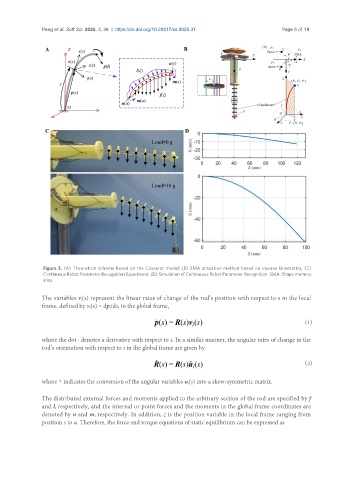
                Figure 3. (A) Theoretical scheme based on the Cosserat model; (B) SMA actuation method based on inverse kinematics; (C)
                Continuous Robot Parameter Recognition Experiment; (D) Simulation of Continuous Robot Parameter Recognition. SMA: Shape memory
                alloy.


               The variables v(s) represent the linear rates of change of the rod’s position with respect to s in the local
                            l
               frame, defined by v(s) = dp/ds, in the global frame,
                                      l
                               l
                                                                                                        (1)


               where the dot · denotes a derivative with respect to s. In a similar manner, the angular rates of change in the
               rod’s orientation with respect to s in the global frame are given by


                                                                                                        (2)


               where ^ indicates the conversion of the angular variables u(s) into a skew-symmetric matrix.
                                                                l
               The distributed external forces and moments applied to the arbitrary section of the rod are specified by f
               and l, respectively, and the internal or point forces and the moments in the global frame coordinates are
               denoted by n and m, respectively. In addition, ξ is the position variable in the local frame ranging from
               position s to a. Therefore, the force and torque equations of static equilibrium can be expressed as

