


Page 117 - Read Online
P. 117
Peng et al. Soft Sci. 2025, 5, 38  https://dx.doi.org/10.20517/ss.2025.31        Page 3 of 19


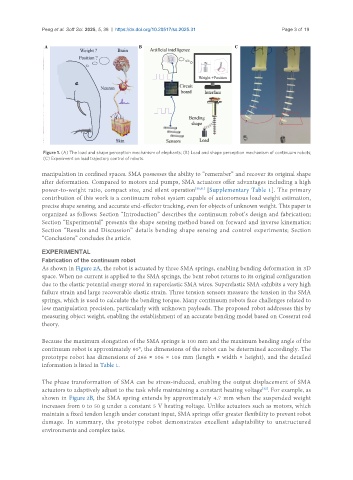
                Figure 1. (A) The load and shape perception mechanism of elephants; (B) Load and shape perception mechanism of continuum robots;
                (C) Experiment on load trajectory control of robots.

               manipulation in confined spaces. SMA possesses the ability to “remember” and recover its original shape
               after deformation. Compared to motors and pumps, SMA actuators offer advantages including a high
               power-to-weight ratio, compact size, and silent operation [30,31]  [Supplementary Table 1]. The primary
               contribution of this work is a continuum robot system capable of autonomous load weight estimation,
               precise shape sensing, and accurate end-effector tracking, even for objects of unknown weight. This paper is
               organized as follows: Section “Introduction” describes the continuum robot’s design and fabrication;
               Section “Experimental” presents the shape sensing method based on forward and inverse kinematics;
               Section “Results and Discussion” details bending shape sensing and control experiments; Section
               “Conclusions” concludes the article.

               EXPERIMENTAL
               Fabrication of the continuum robot
               As shown in Figure 2A, the robot is actuated by three SMA springs, enabling bending deformation in 3D
               space. When no current is applied to the SMA springs, the bent robot returns to its original configuration
               due to the elastic potential energy stored in superelastic SMA wires. Superelastic SMA exhibits a very high
               failure strain and large recoverable elastic strain. Three tension sensors measure the tension in the SMA
               springs, which is used to calculate the bending torque. Many continuum robots face challenges related to
               low manipulation precision, particularly with unknown payloads. The proposed robot addresses this by
               measuring object weight, enabling the establishment of an accurate bending model based on Cosserat rod
               theory.


               Because the maximum elongation of the SMA springs is 100 mm and the maximum bending angle of the
               continuum robot is approximately 90°, the dimensions of the robot can be determined accordingly. The
               prototype robot has dimensions of 266 × 106 × 106 mm (length × width × height), and the detailed
               information is listed in Table 1.


               The phase transformation of SMA can be stress-induced, enabling the output displacement of SMA
                                                                                         [32]
               actuators to adaptively adjust to the task while maintaining a constant heating voltage . For example, as
               shown in Figure 2B, the SMA spring extends by approximately 4.7 mm when the suspended weight
               increases from 0 to 50 g under a constant 5 V heating voltage. Unlike actuators such as motors, which
               maintain a fixed tendon length under constant input, SMA springs offer greater flexibility to prevent robot
               damage.  In  summary,  the  prototype  robot  demonstrates  excellent  adaptability  to  unstructured
               environments and complex tasks.

