


Page 118 - Read Online
P. 118
Page 4 of 19                           Peng et al. Soft Sci. 2025, 5, 38  https://dx.doi.org/10.20517/ss.2025.31

               Table 1. Mechanical parameters of the robot
                Superelastic SMA            Young’s modulus                               56 GPa
                                            Length                                        120 mm
                                            Diameter                                      0.8 mm
                SMA springs                 Diameter                                      3 mm
                                            Length                                        15 mm
                                            Maximum output displacement                   85 mm
                                            Maximum output force                          7 N
                                            SMA wire diameter                             0.6 mm
                Tension sensor              Rated voltage                                 5-10 VDC
                                            Range                                         0-500 g
                                            Weight                                        4.9 g

               SMA: Shape memory alloy.


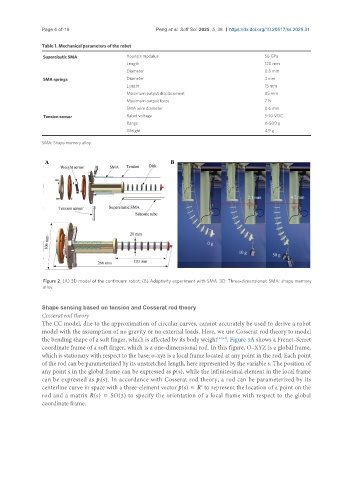
                Figure 2. (A) 3D model of the continuum robot; (B) Adaptivity experiment with SMA. 3D: Three-dimensional; SMA: shape memory
                alloy.


               Shape sensing based on tension and Cosserat rod theory
               Cosserat rod theory
               The CC model, due to the approximation of circular curves, cannot accurately be used to derive a robot
               model with the assumption of no gravity or no external loads. Here, we use Cosserat rod theory to model
               the bending shape of a soft finger, which is affected by its body weight [33,34] . Figure 3A shows a Frenet–Serret
               coordinate frame of a soft finger, which is a one-dimensional rod. In this figure, O–XYZ is a global frame,
               which is stationary with respect to the base; o–xyz is a local frame located at any point in the rod. Each point
               of the rod can be parameterized by its unstretched length, here represented by the variable s. The position of
               any point s in the global frame can be expressed as p(s), while the infinitesimal element in the local frame
               can be expressed as p (s). In accordance with Cosserat rod theory, a rod can be parameterized by its
                                   l
               centerline curve in space with a three-element vector p(s) ∈ R  to represent the location of a point on the
                                                                     3
               rod and a matrix R(s) ∈ SO(3) to specify the orientation of a local frame with respect to the global
               coordinate frame.

