


Page 84 - Read Online
P. 84
Page 8 of 27                            Wang et al. Soft Sci 2024;4:32  https://dx.doi.org/10.20517/ss.2024.15


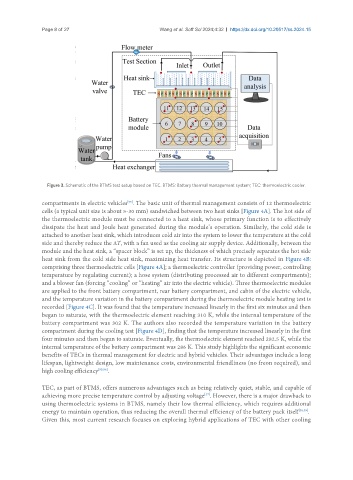
                 Figure 3. Schematic of the BTMS test setup based on TEC. BTMS: Battery thermal management system; TEC: thermoelectric cooler.

               compartments in electric vehicles . The basic unit of thermal management consists of 12 thermoelectric
                                            [55]
               cells (a typical unit size is about 5-30 mm) sandwiched between two heat sinks [Figure 4A]. The hot side of
               the thermoelectric module must be connected to a heat sink, whose primary function is to effectively
               dissipate the heat and Joule heat generated during the module’s operation. Similarly, the cold side is
               attached to another heat sink, which introduces cold air into the system to lower the temperature at the cold
               side and thereby reduce the ΔT, with a fan used as the cooling air supply device. Additionally, between the
               module and the heat sink, a “spacer block” is set up, the thickness of which precisely separates the hot side
               heat sink from the cold side heat sink, maximizing heat transfer. Its structure is depicted in Figure 4B:
               comprising three thermoelectric cells [Figure 4A]; a thermoelectric controller (providing power, controlling
               temperature by regulating current); a hose system (distributing processed air to different compartments);
               and a blower fan (forcing “cooling” or “heating” air into the electric vehicle). Three thermoelectric modules
               are applied to the front battery compartment, rear battery compartment, and cabin of the electric vehicle,
               and the temperature variation in the battery compartment during the thermoelectric module heating test is
               recorded [Figure 4C]. It was found that the temperature increased linearly in the first six minutes and then
               began to saturate, with the thermoelectric element reaching 310 K, while the internal temperature of the
               battery compartment was 302 K. The authors also recorded the temperature variation in the battery
               compartment during the cooling test [Figure 4D], finding that the temperature increased linearly in the first
               four minutes and then began to saturate. Eventually, the thermoelectric element reached 282.5 K, while the
               internal temperature of the battery compartment was 286 K. This study highlights the significant economic
               benefits of TECs in thermal management for electric and hybrid vehicles. Their advantages include a long
               lifespan, lightweight design, low maintenance costs, environmental friendliness (no freon required), and
               high cooling efficiency [55,56] .


               TEC, as part of BTMS, offers numerous advantages such as being relatively quiet, stable, and capable of
               achieving more precise temperature control by adjusting voltage . However, there is a major drawback to
                                                                      [57]
               using thermoelectric systems in BTMS, namely their low thermal efficiency, which requires additional
               energy to maintain operation, thus reducing the overall thermal efficiency of the battery pack itself [58,59] .
               Given this, most current research focuses on exploring hybrid applications of TEC with other cooling

