


Page 81 - Read Online
P. 81
Wang et al. Soft Sci 2024;4:32  https://dx.doi.org/10.20517/ss.2024.15           Page 5 of 27

               PRINCIPLES
               Lithium battery heating principles and heat transfer characteristics
               Designing an effective BTMS requires a thorough understanding of the heat generation and transfer
               mechanisms in power batteries. During charging and discharging, the heat produced in a power battery
                                                                                                       [36]
               primarily consists of four components: polarization heat, reaction heat, side reaction heat, and Joule heat .
               For lithium-ion power batteries, the side reaction heat is mainly caused by battery aging, which generates
               very little heat due to the slow aging process and can therefore be neglected. When considering battery heat
               generation, only reaction heat, polarization heat, and Joule heat need to be considered. Reaction heat (Q ) is
                                                                                                       r
               the heat generated by complex chemical reactions inside the battery; meanwhile, the presence of internal
               resistance in the battery also produces Joule heat (Q); polarization heat (Q ) is generated by the polarization
                                                                              p
                                                           j
               resistance per unit time . In the power system of new energy vehicles, batteries need to have characteristics
                                   [36]
               such as large capacity and high C-rate. Moreover, the high temperatures generated by the battery pack,
               especially under uncertain environmental conditions, increase operational risks, potentially leading to fires
               or even explosions. Therefore, researching the heat generation mechanism of lithium-ion batteries over
               varying periods is crucial to ensure their safe use. Understanding the heat transfer characteristics of lithium-
               ion batteries is essential for more accurate thermal simulation and modeling. Heat transfer occurs through
               three main methods: conduction, convection, and radiation. Considering the structure of lithium-ion
               batteries and their pack configuration, it is known that heat transfer primarily occurs through conduction
               within the battery and convection externally. Therefore, current heat dissipation techniques mainly leverage
               these two heat transfer methods.

               Structure of TEC-based BTMS
               The schematic diagram illustrates a simplified BTMS using TEC modules in Figure 2. The TEC module can
               be divided into three parts: the cold side, the hot side, and the p-n junction [Figure 2A] [37,38] . The top (cold
               side) of the TEC is connected to the battery, while the bottom (hot side) is connected to the air or a liquid as
               a heat transfer medium via a heat sink. The heat produced by the battery is transferred from the top to the
               bottom, causing the top to cool down and thus reducing the battery temperature. Precise temperature
               control is achieved by adjusting the current. Additionally, the system can heat the battery by reversing the
               direction of the TEC’s current. Therefore, with the TEC layout fixed, the battery temperature can be
               controlled to the desired level by changing the direction and magnitude of the DC.

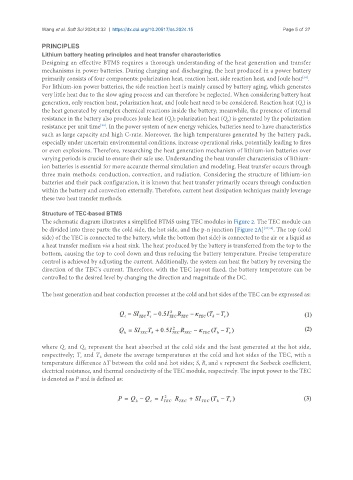
               The heat generation and heat conduction processes at the cold and hot sides of the TEC can be expressed as:


               where Q  and Q  represent the heat absorbed at the cold side and the heat generated at the hot side,
                             h
                       c
               respectively; T  and T  denote the average temperatures at the cold and hot sides of the TEC, with a
                                   h
                            c
               temperature difference ΔT between the cold and hot sides; S, R, and κ represent the Seebeck coefficient,
               electrical resistance, and thermal conductivity of the TEC module, respectively. The input power to the TEC
               is denoted as P and is defined as:

