


Page 80 - Read Online
P. 80
Page 4 of 27                            Wang et al. Soft Sci 2024;4:32  https://dx.doi.org/10.20517/ss.2024.15

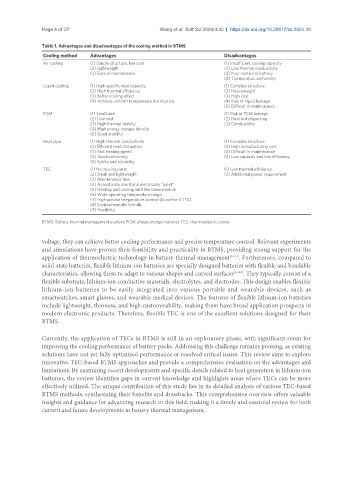
               Table 1. Advantages and disadvantages of the cooling method in BTMS
                Cooling method  Advantages                                   Disadvantages
                Air cooling    (1) Simple structure, low cost                (1) Insufficient cooling capacity
                               (2) Lightweight                               (2) Low thermal conductivity
                               (3) Ease of maintenance                       (3) Poor control of battery
                                                                             (4) Temperature uniformity
                Liquid cooling  (1) High specific heat capacity              (1) Complex structure
                               (2) High thermal efficiency                   (2) Heavyweight
                               (3) Better cooling effect                     (3) High cost
                               (4) Achieve uniform temperature distribution  (4) Risk of liquid leakage
                                                                             (5) Difficult in maintenance
                PCM            (1) Small size                                (1) Risk of PCM leakage
                               (2) Low cost                                  (2) Heat not dispersing
                               (3) High thermal density                      (3) Combustible
                               (4) High energy storage density
                               (5) Good stability
                Heat pipe      (1) High thermal conductivity                 (1) Complex structure
                               (2) Efficient heat dissipation                (2) High manufacturing cost
                               (3) Fast heating speed                        (3) Difficult in maintenance
                               (4) Good uniformity                           (4) Low capacity and low efficiency
                               (5) Safety and reliability
                TEC            (1) No moving parts                           (1) Low thermal efficiency
                               (2) Small and lightweight                     (2) Additional power requirement
                               (3) Maintenance free
                               (4) Acoustically silent and electrically “quiet”
                               (5) Heating and cooling with the same module
                               (6) Wide operating temperature range
                               (7) High precise temperature control (to within 0.1 °C)
                               (8) Environmentally friendly
                               (9) Flexibility
               BTMS: Battery thermal management system; PCM: phase change material; TEC: thermoelectric cooler.


               voltage, they can achieve better cooling performance and precise temperature control. Relevant experiments
               and simulations have proven their feasibility and practicality in BTMS, providing strong support for the
               application of thermoelectric technology in battery thermal management [32,33] . Furthermore, compared to
               solid-state batteries, flexible lithium-ion batteries are specially designed batteries with flexible and bendable
               characteristics, allowing them to adapt to various shapes and curved surfaces [34,35] . They typically consist of a
               flexible substrate, lithium-ion conductive materials, electrolytes, and electrodes. This design enables flexible
               lithium-ion batteries to be easily integrated into various portable and wearable devices, such as
               smartwatches, smart glasses, and wearable medical devices. The features of flexible lithium-ion batteries
               include lightweight, thinness, and high customizability, making them have broad application prospects in
               modern electronic products. Therefore, flexible TEC is one of the excellent solutions designed for their
               BTMS.

               Currently, the application of TECs in BTMS is still in an exploratory phase, with significant room for
               improving the cooling performance of battery packs. Addressing this challenge remains pressing, as existing
               solutions have not yet fully optimized performance or resolved critical issues. This review aims to explore
               innovative TEC-based BTMS approaches and provide a comprehensive evaluation on the advantages and
               limitations. By examining recent developments and specific details related to heat generation in lithium-ion
               batteries, the review identifies gaps in current knowledge and highlights areas where TECs can be more
               effectively utilized. The unique contribution of this study lies in its detailed analysis of various TEC-based
               BTMS methods, synthesizing their benefits and drawbacks. This comprehensive overview offers valuable
               insights and guidance for advancing research in this field, making it a timely and essential review for both
               current and future developments in battery thermal management.

