


Page 82 - Read Online
P. 82
Page 6 of 27                            Wang et al. Soft Sci 2024;4:32  https://dx.doi.org/10.20517/ss.2024.15


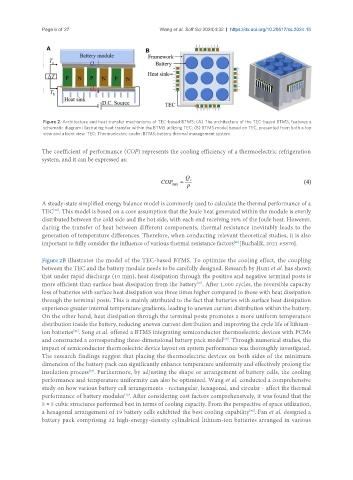
                Figure 2. Architecture and heat transfer mechanisms of TEC-based BTMS: (A) The architecture of the TEC-based BTMS, features a
                schematic diagram illustrating heat transfer within the BTMS utilizing TEC; (B) BTMS model based on TEC, presented from both a top
                view and a front view. TEC: Thermoelectric cooler; BTMS: battery thermal management system.

               The coefficient of performance (COP) represents the cooling efficiency of a thermoelectric refrigeration
               system, and it can be expressed as:


               A steady-state simplified energy balance model is commonly used to calculate the thermal performance of a
               TEC . This model is based on a core assumption that the Joule heat generated within the module is evenly
                   [39]
               distributed between the cold side and the hot side, with each end receiving 50% of the Joule heat. However,
               during the transfer of heat between different components, thermal resistance inevitably leads to the
               generation of temperature differences. Therefore, when conducting relevant theoretical studies, it is also
               important to fully consider the influence of various thermal resistance factors [Buchalik, 2021 #3870].
                                                                                [40]

               Figure 2B illustrates the model of the TEC-based BTMS. To optimize the cooling effect, the coupling
               between the TEC and the battery module needs to be carefully designed. Research by Hunt et al. has shown
               that under rapid discharge (10 min), heat dissipation through the positive and negative terminal posts is
               more efficient than surface heat dissipation from the battery . After 1,000 cycles, the reversible capacity
                                                                   [41]
               loss of batteries with surface heat dissipation was three times higher compared to those with heat dissipation
               through the terminal posts. This is mainly attributed to the fact that batteries with surface heat dissipation
               experience greater internal temperature gradients, leading to uneven current distribution within the battery.
               On the other hand, heat dissipation through the terminal posts promotes a more uniform temperature
               distribution inside the battery, reducing uneven current distribution and improving the cycle life of lithium-
               ion batteries . Song et al. offered a BTMS integrating semiconductor thermoelectric devices with PCMs
                          [41]
               and constructed a corresponding three-dimensional battery pack model . Through numerical studies, the
                                                                            [38]
               impact of semiconductor thermoelectric device layout on system performance was thoroughly investigated.
               The research findings suggest that placing the thermoelectric devices on both sides of the minimum
               dimension of the battery pack can significantly enhance temperature uniformity and effectively prolong the
               insulation process . Furthermore, by adjusting the shape or arrangement of battery cells, the cooling
                               [38]
               performance and temperature uniformity can also be optimized. Wang et al. conducted a comprehensive
               study on how various battery cell arrangements - rectangular, hexagonal, and circular - affect the thermal
                                           [42]
               performance of battery modules . After considering cost factors comprehensively, it was found that the
               5 × 5 cubic structures performed best in terms of cooling capacity. From the perspective of space utilization,
               a hexagonal arrangement of 19 battery cells exhibited the best cooling capability . Fan et al. designed a
                                                                                     [42]
               battery pack comprising 32 high-energy-density cylindrical lithium-ion batteries arranged in various

