


Page 79 - Read Online
P. 79
Wang et al. Soft Sci 2024;4:32  https://dx.doi.org/10.20517/ss.2024.15           Page 3 of 27


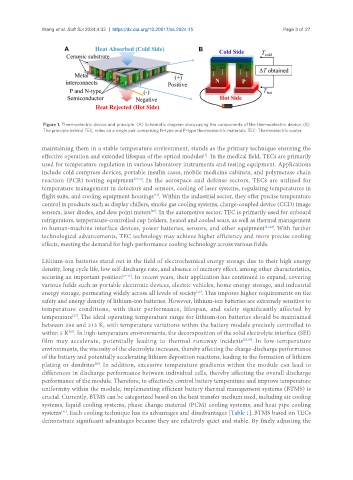
                Figure 1. Thermoelectric device and principle: (A) Schematic diagram showcasing the components of the thermoelectric device; (B)
                The principle behind TEC, relies on a single pair comprising N-type and P-type thermoelectric materials. TEC: Thermoelectric cooler.

               maintaining them in a stable temperature environment, stands as the primary technique ensuring the
                                                                      [3]
               effective operation and extended lifespan of the optical modules . In the medical field, TECs are primarily
               used for temperature regulation in various laboratory instruments and testing equipment. Applications
               include cold compress devices, portable insulin cases, mobile medicine cabinets, and polymerase chain
               reaction (PCR) testing equipment [17,18] . In the aerospace and defense sectors, TECs are utilized for
               temperature management in detectors and sensors, cooling of laser systems, regulating temperatures in
               flight suits, and cooling equipment housings . Within the industrial sector, they offer precise temperature
                                                     [19]
               control in products such as display chillers, smoke gas cooling systems, charge-coupled device (CCD) image
                                                    [20]
               sensors, laser diodes, and dew point meters . In the automotive sector, TEC is primarily used for onboard
               refrigerators, temperature-controlled cup holders, heated and cooled seats, as well as thermal management
               in human-machine interface devices, power batteries, sensors, and other equipment [21,22] . With further
               technological advancements, TEC technology may achieve higher efficiency and more precise cooling
               effects, meeting the demand for high-performance cooling technology across various fields.


               Lithium-ion batteries stand out in the field of electrochemical energy storage due to their high energy
               density, long cycle life, low self-discharge rate, and absence of memory effect, among other characteristics,
               securing an important position [23-25] . In recent years, their application has continued to expand, covering
               various fields such as portable electronic devices, electric vehicles, home energy storage, and industrial
                                                                   [26]
               energy storage, permeating widely across all levels of society . This imposes higher requirements on the
               safety and energy density of lithium-ion batteries. However, lithium-ion batteries are extremely sensitive to
               temperature  conditions,  with  their  performance,  lifespan,  and  safety  significantly  affected  by
               temperature . The ideal operating temperature range for lithium-ion batteries should be maintained
                         [27]
               between 298 and 313 K, with temperature variations within the battery module precisely controlled to
                        [28]
               within 5 K . In high-temperature environments, the decomposition of the solid electrolyte interface (SEI)
               film  may  accelerate,  potentially  leading  to  thermal  runaway  incidents [29,30] . In  low-temperature
               environments, the viscosity of the electrolyte increases, thereby affecting the charge-discharge performance
               of the battery and potentially accelerating lithium deposition reactions, leading to the formation of lithium
                                 [29]
               plating or dendrites . In addition, excessive temperature gradients within the module can lead to
               differences in discharge performance between individual cells, thereby affecting the overall discharge
               performance of the module. Therefore, to effectively control battery temperature and improve temperature
               uniformity within the module, implementing efficient battery thermal management systems (BTMS) is
               crucial. Currently, BTMS can be categorized based on the heat transfer medium used, including air cooling
               systems, liquid cooling systems, phase change material (PCM) cooling systems, and heat pipe cooling
               systems . Each cooling technique has its advantages and disadvantages [Table 1]. BTMS based on TECs
                      [31]
               demonstrate significant advantages because they are relatively quiet and stable. By finely adjusting the

