


Page 74 - Read Online
P. 74
Wang. Soft Sci 2024;4:25  https://dx.doi.org/10.20517/ss.2024.14                 Page 7 of 9


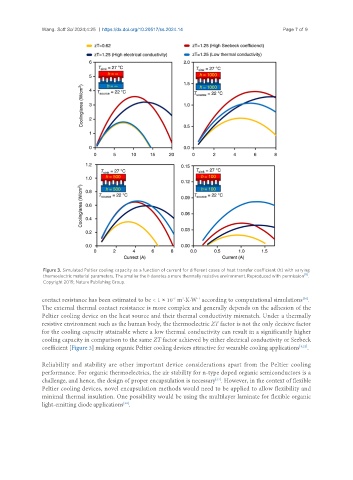
                Figure 3. Simulated Peltier cooling capacity as a function of current for different cases of heat transfer coefficient (h) with varying
                                                                                                        [8]
                thermoelectric material parameters. The smaller the h denotes a more thermally resistive environment. Reproduced with permission .
                Copyright 2019, Nature Publishing Group.
                                                           -7
                                                                                                       [36]
               contact resistance has been estimated to be < 1 × 10  m ·K·W  according to computational simulations .
                                                                   -1
                                                              2
               The external thermal contact resistance is more complex and generally depends on the adhesion of the
               Peltier cooling device on the heat source and their thermal conductivity mismatch. Under a thermally
               resistive environment such as the human body, the thermoelectric ZT factor is not the only decisive factor
               for the cooling capacity attainable where a low thermal conductivity can result in a significantly higher
               cooling capacity in comparison to the same ZT factor achieved by either electrical conductivity or Seebeck
               coefficient [Figure 3] making organic Peltier cooling devices attractive for wearable cooling applications [8,22] .


               Reliability and stability are other important device considerations apart from the Peltier cooling
               performance. For organic thermoelectrics, the air stability for n-type doped organic semiconductors is a
               challenge, and hence, the design of proper encapsulation is necessary . However, in the context of flexible
                                                                          [37]
               Peltier cooling devices, novel encapsulation methods would need to be applied to allow flexibility and
               minimal thermal insulation. One possibility would be using the multilayer laminate for flexible organic
               light-emitting diode applications .
                                           [38]

